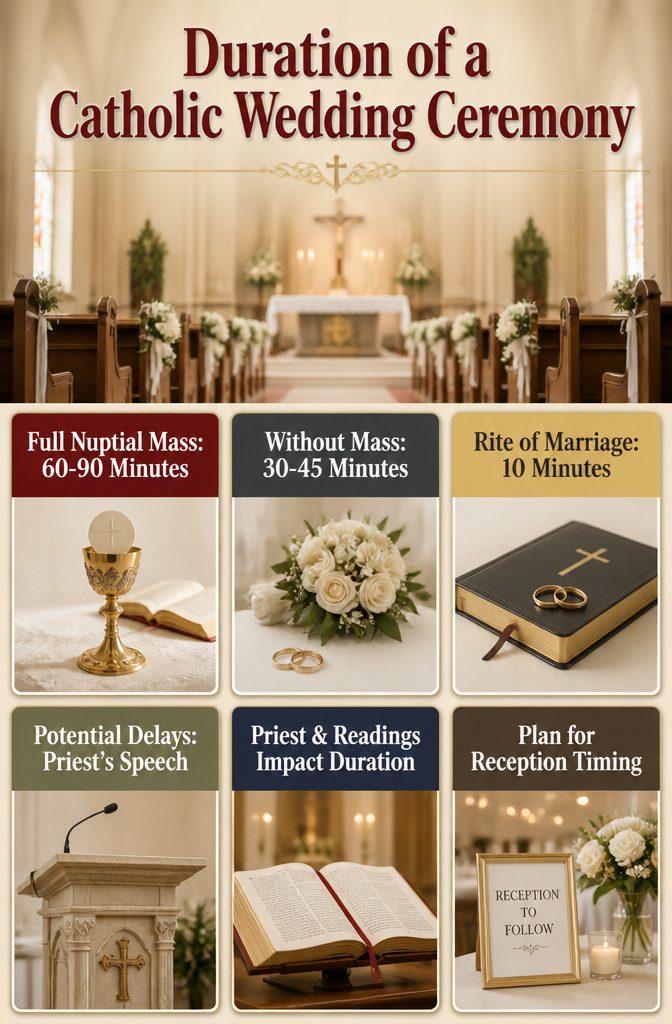
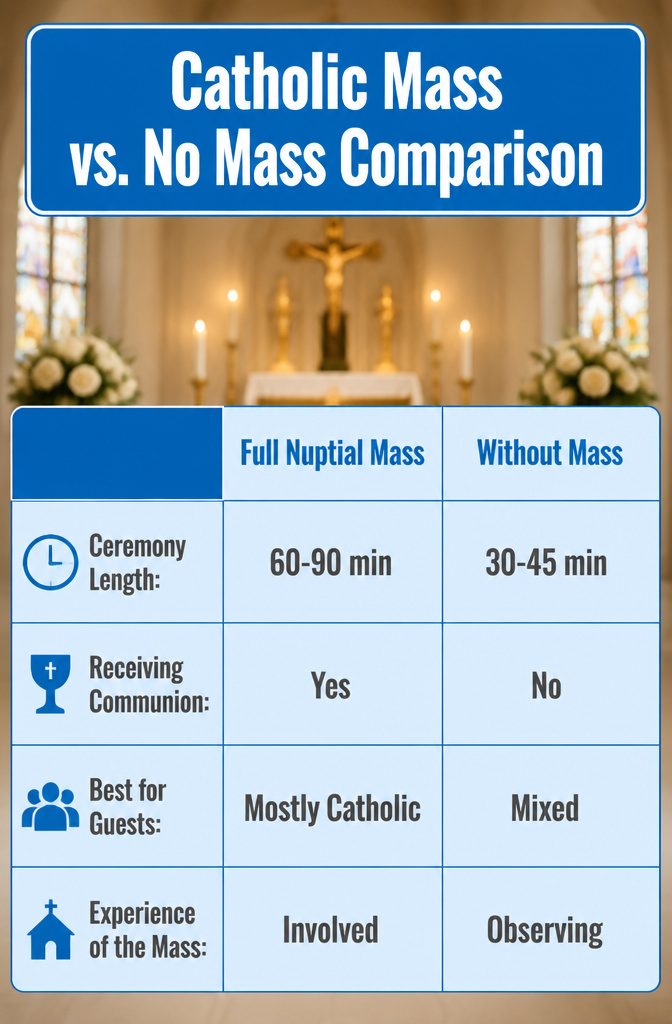
A Catholic wedding takes 30 to 45 minutes without Mass, or 60 to 90 minutes with a full nuptial Mass. The gap between those two forms is not a rounding error; it is the difference between cocktails starting on time and guests still standing in the church parking lot. One couple’s ceremony stretched past 90 minutes because their priest ran long on the homily and the music extended. Ask your priest early which form you are having, then ask again for his realistic run time with your specific church and music.
How Long a Catholic Wedding Takes
The first time I sat through a full Catholic wedding as a guest, I showed up expecting something like the twenty-minute civil ceremony I’d been to the month before. An hour later we were still in the pew, communion line stretching past the third row, and I had to text my ride to stop circling the block.
A full nuptial mass runs 60 to 90 minutes, while a ceremony without mass lasts 30 to 45 minutes. The Rite of Marriage itself, the legal heart of it, takes about ten minutes. The rest is the mass, the readings, the homily, the petitions. A priest who speaks slowly or chooses extra readings can push the longer end toward that 90-minute mark or beyond. One couple I read about had their ceremony stretch past an hour and a half because their priest was generous with the homily and the music ran long.
If you’re the one booking the venue and the caterer, that 45-minute gap between the two forms is not a rounding error. It is the difference between cocktails starting at 5:15 and guests still standing in the church parking lot at 6:00, wondering where the shuttle went. Ask your priest early which form you’re having, then ask again for his realistic run time with that specific church and that specific music. Build your timeline from the longer number he gives you, not the one you hope for.


What Happens in the Ceremony
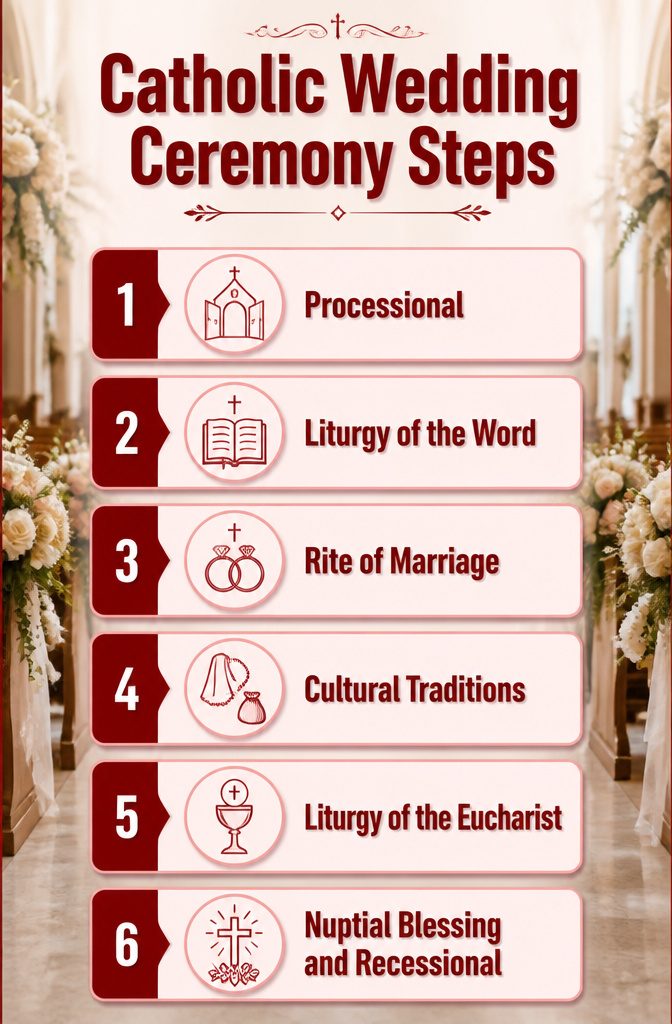
The processional sets the pace. In most parishes the priest enters from the side, then the groom and best man take their place at the altar. The wedding party follows, and the bride enters last. Some couples choose to walk in together, which the rite explicitly allows, though the traditional order still dominates.
The Liturgy of the Word comes next: two or three scripture readings, usually by family or friends you’ve chosen, plus a psalm and the Gospel. The homily follows, and this is where timing goes off-script. One priest might speak five minutes; another, twenty. That variation alone can swing your ceremony from manageable to tight.
The Rite of Marriage itself takes about ten minutes: questions of intention, your vows, the exchange of rings. This is the sacrament, and nothing here gets skipped whether you have a full mass or not.
Cultural traditions, if you’re including them, the veil, el lazo, las arras, the unity candle, usually slot in after the rings or during the nuptial blessing.
The split happens here. A full nuptial mass continues into the Liturgy of the Eucharist: offertory, consecration, communion. A ceremony without mass ends after the blessings. The Church often recommends the shorter form when one partner isn’t Catholic, so half the congregation isn’t seated while the other half receives.
The nuptial blessing, final blessing, and recessional close both versions. Some priests place the first kiss here rather than after vows. Ask beforehand, so nobody’s camera is pointed the wrong way.


Cultural Traditions That Add Time
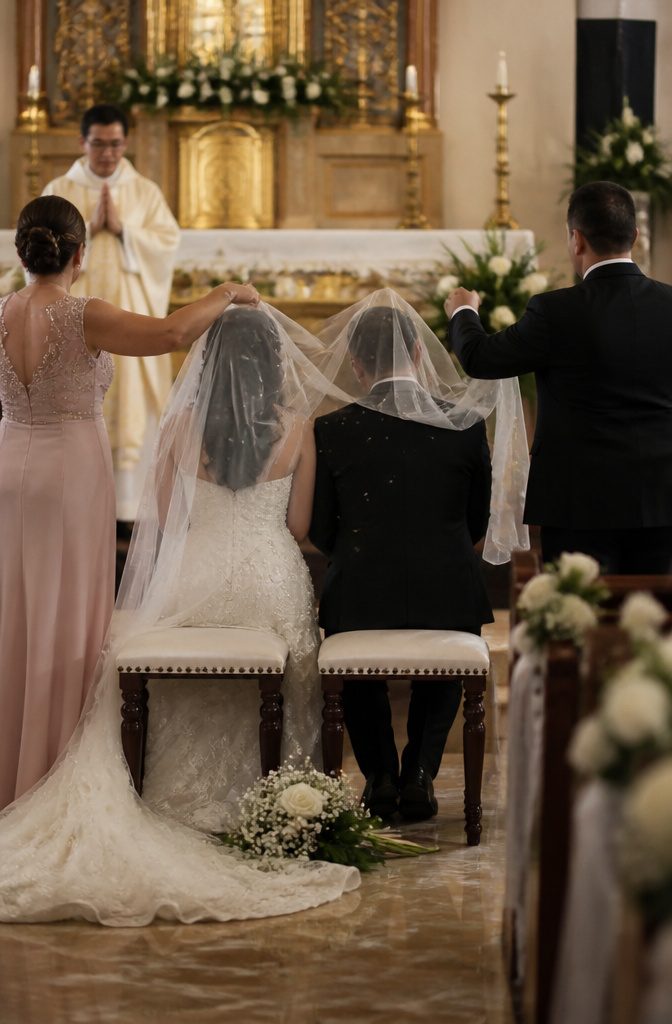
Cultural traditions woven into the liturgy can quietly stretch a 45-minute ceremony past the hour mark. The veiling places a white cloth over the couple together, usually by padrinos, and stays through the nuptial blessing; that single gesture adds two to three minutes, but the real time sits in the pause while sponsors walk forward and settle it into place. El lazo, the figure-eight loop of rosary beads or cord laid over joined hands after the vows, runs another two to four minutes depending on whether the priest explains the symbol to the congregation. Las arras, the thirteen blessed coins passed hand to hand, takes roughly three minutes once you count the priest’s blessing and the deliberate, ceremonial exchange. The unity candle, where two flames meet one, adds two minutes if your parish permits it; not all do, since it sits outside the official rite. Flowers to Mary, offered after communion during an Ave Maria, can stretch five minutes or more with the walk to the statue and the singing. Each tradition alone is brief, but stacking three or four adds fifteen to twenty minutes to the block of time you have booked the church for, and that is before anyone fumbles a cord or drops a coin. Tell your photographer which you are including; the moments pass fast, but the setup does not.


GREAT GIFTS- These reproduction prints make the perfect inspirational gift!
Photography During the Ceremony
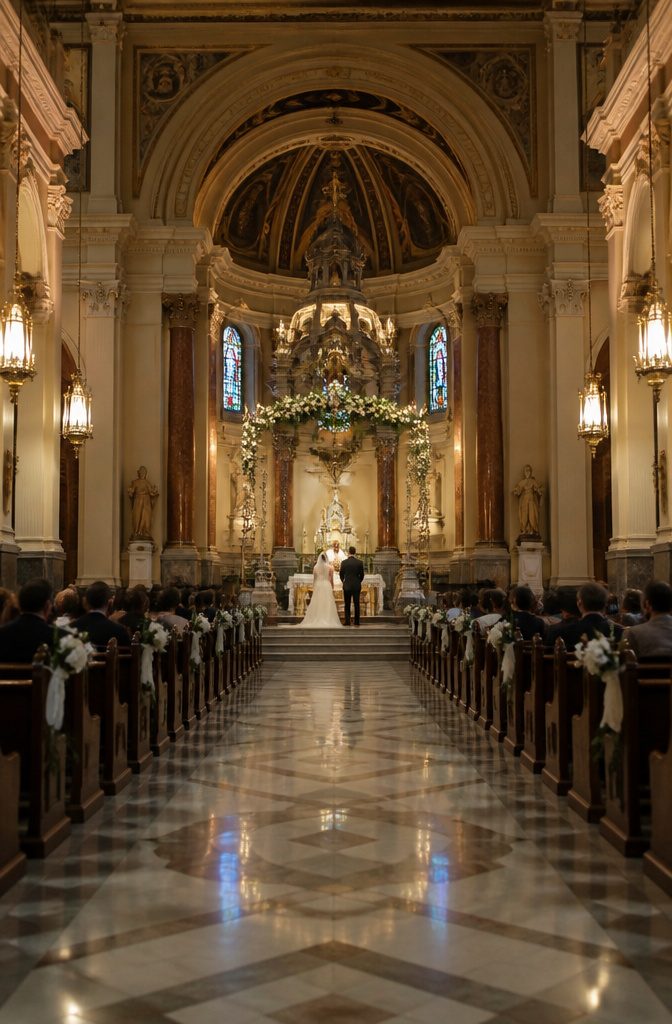
Flash photography is almost always banned during the liturgy, and the restriction shapes more than the lighting. Without it, photographers push ISO higher and shoot wider apertures, which means grainier, softer images in dim churches. The trade-off is worth it: guests stay absorbed in the ceremony instead of flinching at bursts of light, and the photographs gain a warmth that flash would have stripped away.
Movement is the tighter constraint. Most parishes confine photographers to the side aisles or the back, and some prohibit stepping into the sanctuary entirely. A few assign a single spot for the vows. These rules mean the album will lean on long lenses and careful timing rather than the sweeping angle changes couples see in secular ceremony galleries. Guests seated near the aisle notice the photographer’s choreography, the pause at the back during the consecration when some churches demand silence and no photography at all for those minutes.
The fix is a conversation with the priest beforehand, ideally with the parish’s written policy sent to the photographer early. That advance knowledge lets them cover a full 60-to-90-minute nuptial mass without intrusion, or a shorter ceremony without mass, and still deliver the moments that matter. An unplugged ceremony helps too: one guest leaning into the aisle with a phone can block the processional shot that months of planning were aimed at.


The Catholic Gap
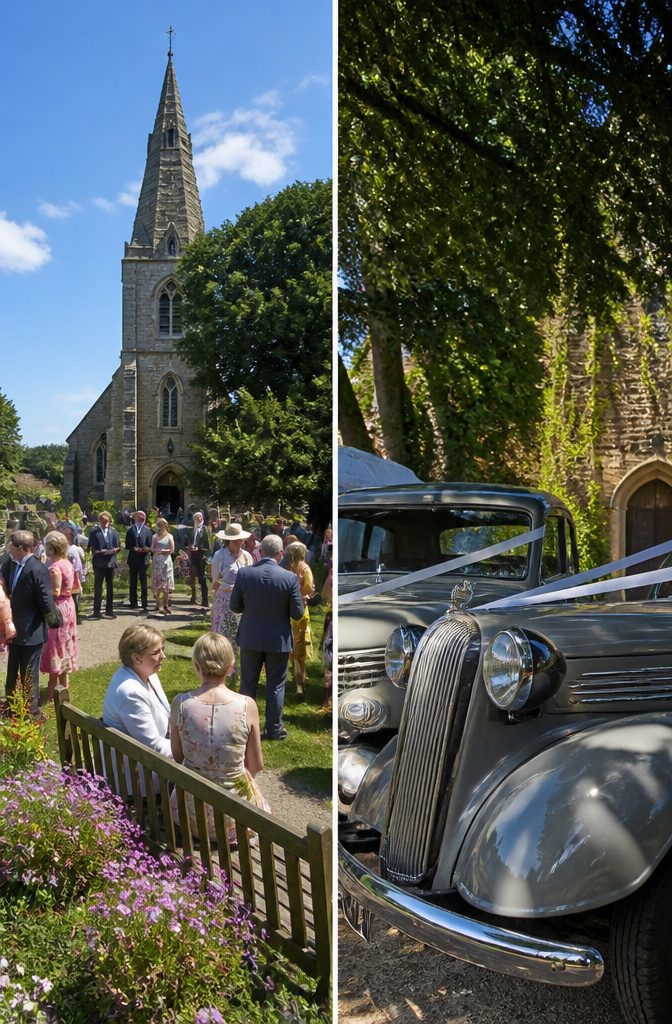
The gap between a Catholic ceremony and the evening reception usually runs 2 to 4 hours, and it can either strand your guests or give them a breather, depending on how you handle it. Most Saturday nuptial Masses end early afternoon because parishes need the sanctuary clear before the vigil Mass starts at 4 p.m. or later, which pushes the reception start to 5 or 6 p.m. at the earliest.
What you tell guests matters. I have seen timelines that simply list "reception at 6:00" and leave everyone wandering; the ones that work hand out a short list of nearby bars, restaurants, parks, or museums so people know where to land. Some hosts open their home for a casual coffee hour, which works especially well when out-of-town family wants face time without the formality of the reception. If your crowd is mostly local, they will likely scatter to hotels or their own plans, and that is fine too.
Transportation needs thinking through. One timeline I studied runs a guest shuttle from the church starting right after the ceremony, then holds the wedding party back for family photos before a second shuttle departs at 3:30 p.m. The earliest guests arrive around 3:45, so the venue needs soft drinks ready and staff who will not panic about early arrivals. If you are not providing shuttles, be explicit about parking, rideshare pickup spots, and whether the church lot locks after a certain hour. The 30- to 45-minute window some parishes give photographers before clearing the sanctuary already squeezes your photo time; do not lose more minutes to guests circling for directions.

Faith-based Book Mark Magnets: Delight, encourage and inspire with these handy Christian book accessories. Each handsome magnet bookmark has a unique design incorporating Scripture and inspirational messages.


Complete Catholic Bible (73 Books): Includes the full Old and New Testaments with Deuterocanonical books—official Catholic Edition with imprimatur.
Pre-Cana and What Comes Before
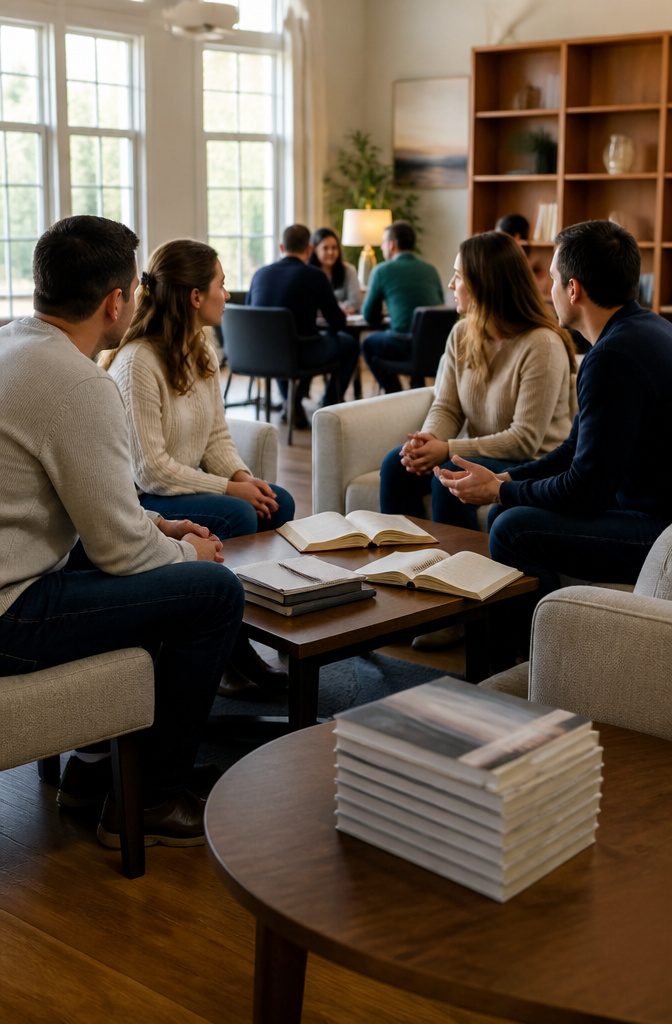
The six-month Pre-Cana program is the gate most couples do not see coming. A Catholic parish will not set a date until this preparation is underway, which means the ceremony length you are Googling in 2026 is already shaped by a clock that started half a year earlier.
Pre-Cana covers money management, parenting expectations, intimacy, and the church’s view of marriage as a sacrament. Some dioceses, including the Archdiocese of New York, run it in person; others approve online sessions if you clear it with your priest first. Either way, the content is not a formality. It is the church’s condition for permission to marry at all.
This is where the timeline surprises bite. A parish I called while researching this needed six to twelve months’ notice just to book a Saturday slot, and that booking assumes Pre-Cana is already finished or in progress. Couples who imagine they can pick a church four months out learn they are already late. The ceremony length on the day, whether forty minutes without Mass or closer to ninety with it, depends on a preparation phase that happens well before the dress fitting or the RSVP cards.


Choosing Mass or No Mass
The first thing the priest asked us was whether both of us were Catholic. Only one partner needs to be Catholic to marry in the Church, but at least one must be, and the non-Catholic needs permission from the bishop. That permission is routine, not a loophole, and the priest handles the paperwork during Pre-Cana.
If both of you are Catholic, the full nuptial mass is the expected form. It runs 60–90 minutes, communion included, with the Liturgy of the Eucharist coming after your vows. Everyone who is a practicing Catholic in good standing may receive; guests who are not simply stay seated or cross their arms for a blessing. The Church often recommends the ceremony without mass, 30–45 minutes, when one partner isn’t Catholic so half your guests aren’t watching the other half participate in something they can’t share. Either form produces a fully valid marriage.
Guest count and background matter practically, not theologically. A room where most guests are unfamiliar with the rhythm of mass will feel longer than it is; a mostly Catholic crowd moves through the responses and communion with less friction. One wedding I read about had a deacon presiding, which meant no consecration at all, just a communion service using pre-blessed hosts. That sat somewhere between the two forms.
The real decision point is what your guests will experience and whether the extra 45 minutes changes your reception timing. Ask your priest for his realistic run time with your music and readings chosen, then work backward from that number.

This App has a collection of Christian Love Wedding Songs with Lyrics


Frequently Asked Questions
How long is a Catholic wedding?
A full nuptial mass runs 60 to 90 minutes, while a ceremony without mass lasts 30 to 45 minutes. The difference comes down to whether the Liturgy of the Eucharist, communion, is included after the vows. Ask your priest for his realistic run time with your specific music and readings, then build your reception timeline from that longer number.
What happens during a Catholic wedding ceremony?
The ceremony opens with a processional, followed by the Liturgy of the Word with scripture readings and a homily. The Rite of Marriage itself, about ten minutes of vows and ring exchange, forms the sacramental core. A full mass continues with the Liturgy of the Eucharist, while the shorter version ends after blessings and the recessional. Cultural traditions like el lazo or the unity candle may slot in after the rings.
Do you have to be Catholic to get married in a Catholic church?
At least one partner must be Catholic, and the non-Catholic needs permission from the bishop, which the priest handles during Pre-Cana. The Church often recommends the ceremony without mass when one partner is not Catholic, so half the congregation is not seated while the other half receives communion. Either form produces a fully valid marriage.