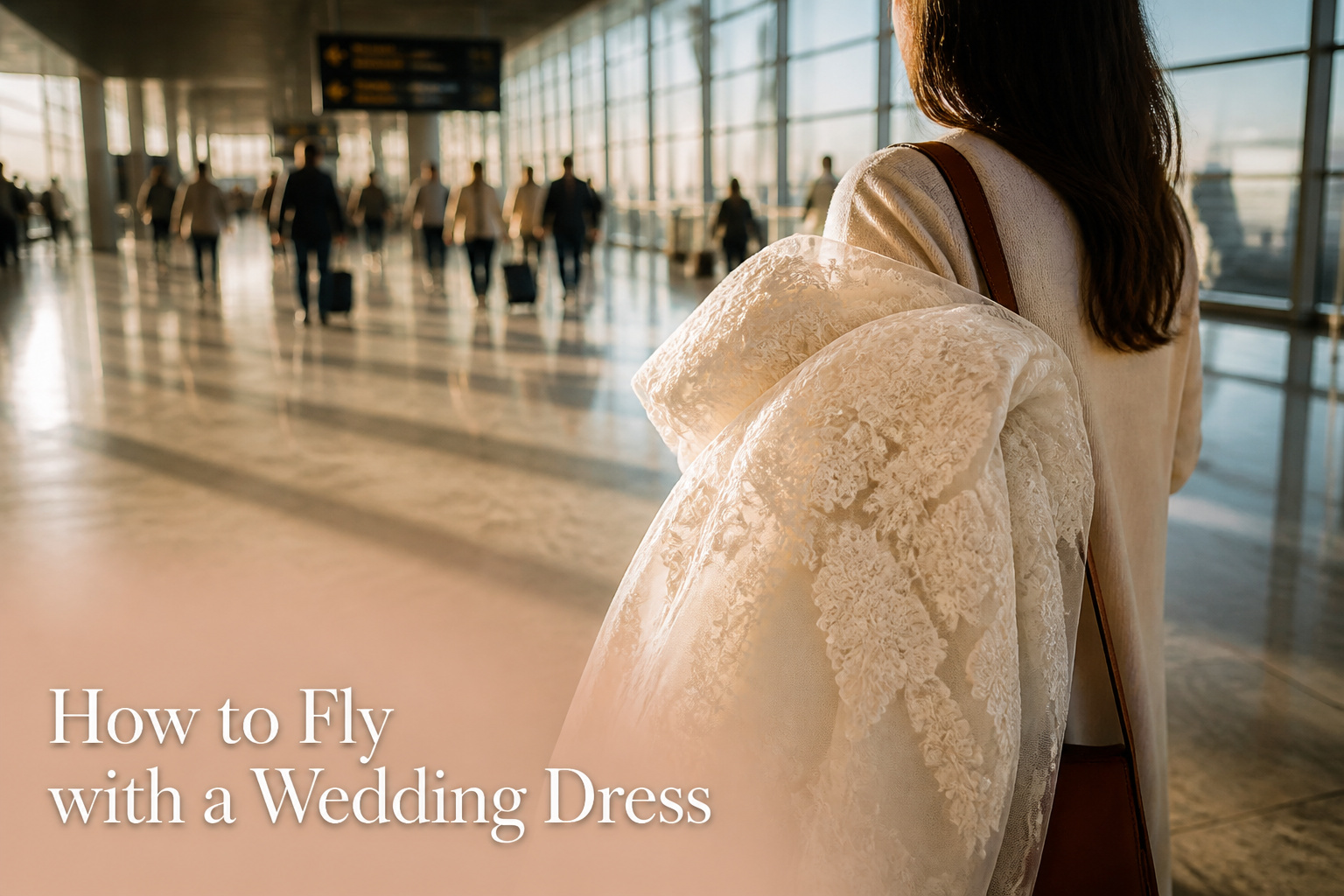
Flying with a wedding dress means carrying it on; no airline guarantees closet space, and a full flight can force you to fold it into an overhead bin or gate-check it against your will.
American Airlines offers the clearest policy, allowing a soft-sided garment bag in place of a carry-on if it meets size rules.
A 60–70 inch bag is the minimum that keeps a long train off airport floors, and acid-free tissue between every fold is the only buffer worth buying against creases you cannot steam out in a hotel bathroom.
1. Choosing the Airline and Class
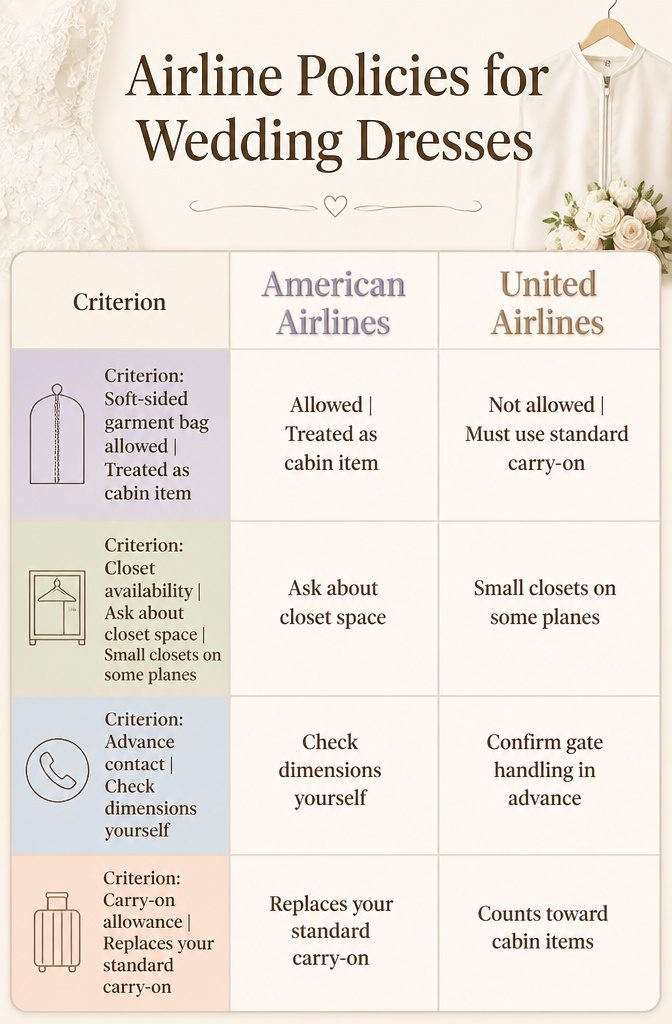
American Airlines allows a soft-sided garment bag in place of a carry-on if it meets their size rules, which is the clearest policy I found when I was booking my own flight last spring.
No airline actually guarantees closet space, not even if you pay extra; the gate crew will try to help, but a full flight or a smaller aircraft can leave you folding that dress into an overhead bin or gate-checking it against your will.
Larger airlines beat budget carriers here because they fly more widebodies with forward coat closets and their crews have more experience handling unusual items.
Premium economy or business class becomes worth the upgrade on long-haul routes like LAX to Paris, where the forward cabin closets sit closer to your seat and the extra bin space gives you a backup if the crew cannot hang it.
For a short domestic hop, the upgrade rarely pays off; the overhead bins suffice and the closet, if it exists, is the same cramped one.
2. The Garment Bag That Actually Protects
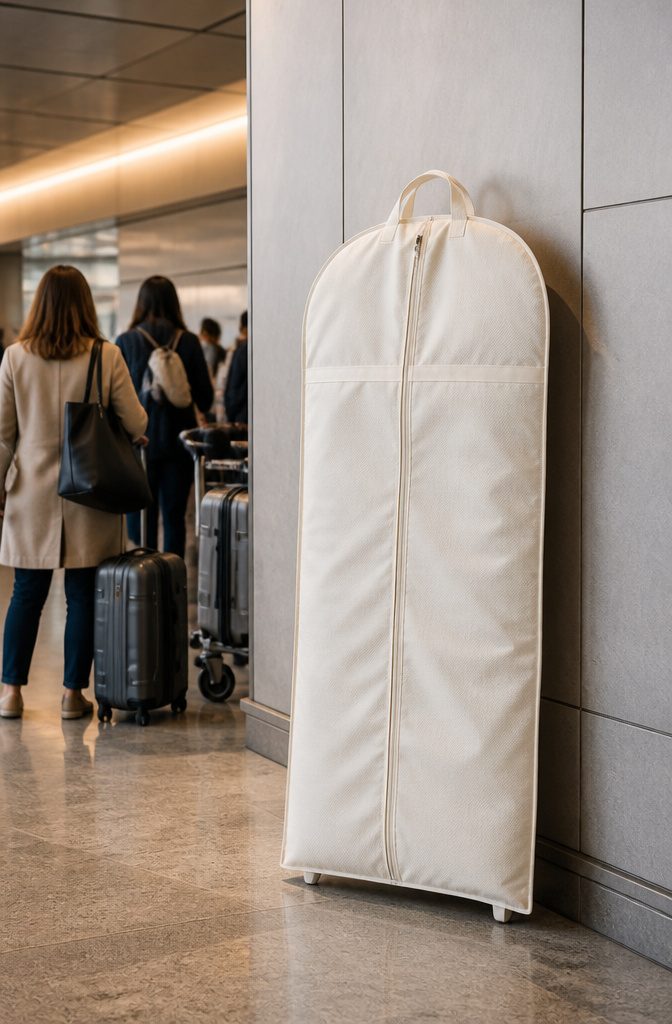
I bought the wrong bag first. The one the boutique gave me was standard length, maybe 48 inches, and my train hung out the bottom like a tail that would drag through airport floors.
For a gown with any real length, 60–70 inches is the minimum that keeps the hem clean and contained.
The WallyBags 60″ Deluxe Bridal Garment Bag is what I should have started with. It is built for wedding gowns specifically, with that extra length and a structure that holds shape when you fold or roll it for the overhead bin.
The Nomatic Garment Bag, which travel editors have tested as a best overall pick, works differently. It is slimmer, designed to strap onto rolling luggage, and suits a fitted or minimalist dress that does not need the bulk.
Two structures, two uses: the WallyBags wins for volume and train length, the Nomatic for mobility and pairing with checked bags.
Amazon lists extra-long bridal bags at 66–70 inches for under twenty dollars.
Quality varies, seams can fail, and the fabric is thin enough that a zipper snag tears through. I would use one only as a backup, not as the single layer between a beaded bodice and a TSA bin.
3. Packing the Dress Without Creases
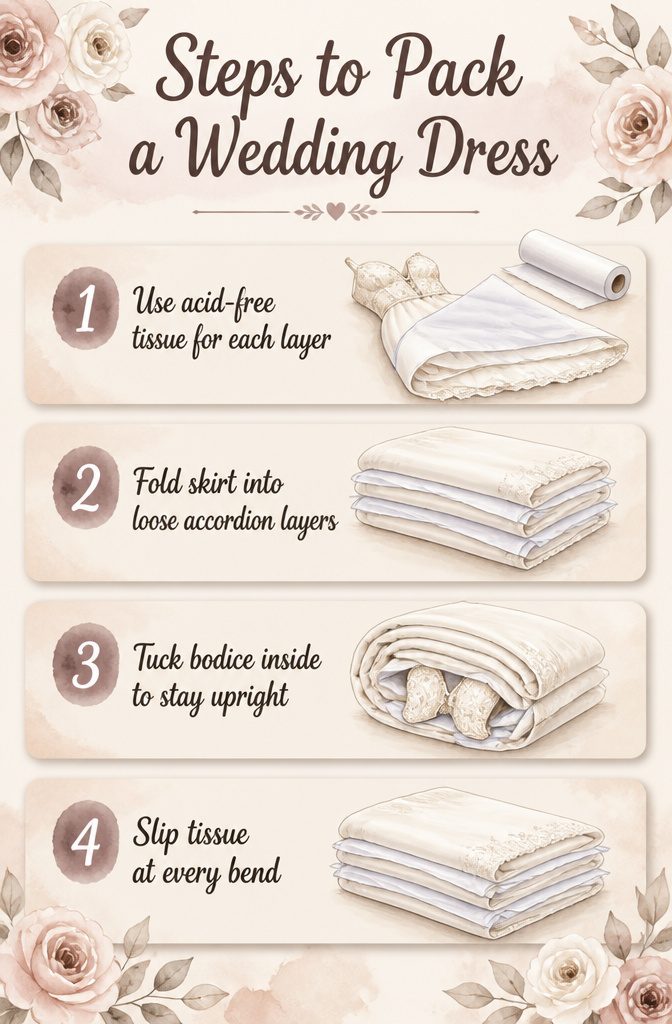
Acid-free tissue is the only buffer worth buying for the folds.
I lay a sheet between each layer of skirt, bodice, and train so the fabric never presses against itself. The tissue keeps beading from biting into tulle and stops satin from taking a crease that a hotel steamer cannot lift.
Rolling sounds gentler, but most gowns fight it. A ballgown’s volume turns into a tight spiral that sets wrinkles deep; a structured bodice warps under its own weight when rolled.
Folding with tissue between the layers wins for anything with a train or heavy skirt. Fold the skirt into loose accordion layers, tuck the bodice inside so the corset stays upright, and slip tissue at every bend.
My own mistake was skipping tissue at the waist seam. I folded a gown too cleanly in half, pressed it flat to fit a carry-on, and found a sharp horizontal line across the satin the next morning.
The mark steamed out, but only after forty minutes of panic in a hotel bathroom. Now I fold in thirds, never halves, and I buy the tissue by the pack rather than hoping the bridal shop has leftovers.
4. Check-In and TSA Screening
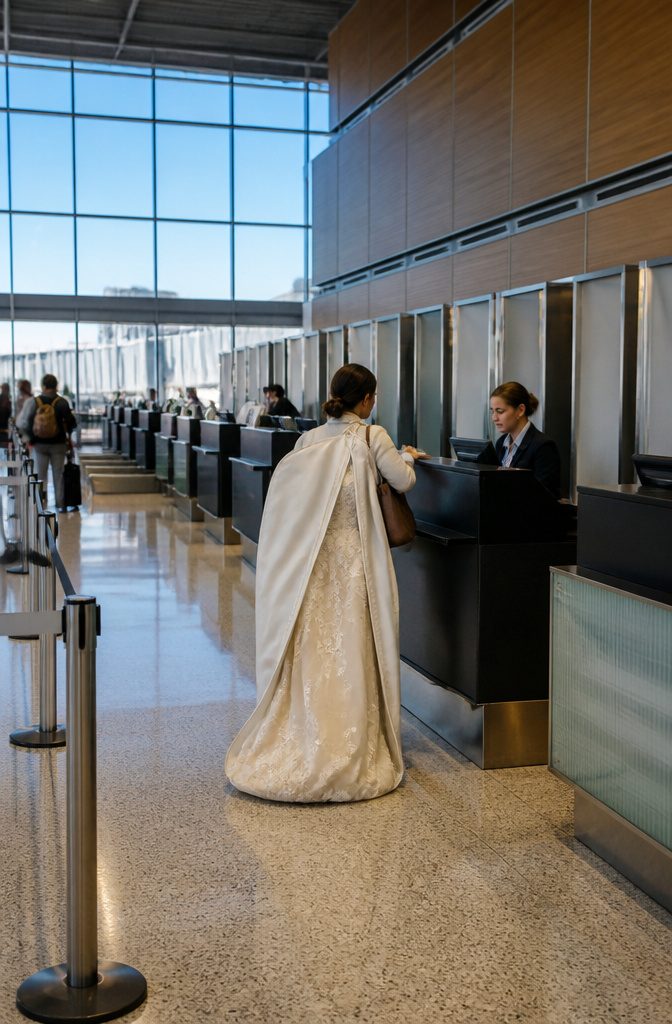
The moment the agent calls the next passenger forward, your stomach tightens.
You have a wedding dress in a garment bag that might be your carry-on, and no idea whether the person behind the counter will treat it as luggage or as something that matters.
Walk up and say it plainly: you have a wedding dress. Ask whether the bag can be ticketed as your carry-on if it fits the airline’s size limits.
If it runs over, ask about gate-checking. The response changes by airline and even by shift, so advance politeness is your actual leverage here, not the printed rules you looked up at home.
TSA screening is where most brides freeze.
Wedding dresses are allowed through security, and a garment-style bag makes the process smoother. Tell the agent you have a gown inside before it enters the X-ray.
They may open the bag for a visual inspection, sometimes a manual one. The fabric itself does not alarm; what slows you down is the surprise of finding it.
Having the dress on its hanger inside the bag, hook pulled through the top opening with the train folded and rolled upward, lets them look without you having to repack in the middle of the checkpoint.
I have watched brides try to fold everything flat into a duffel to avoid attention.
It takes longer, wrinkles more, and draws the inspection anyway. The garment bag is the move.
5. Boarding and Stowing
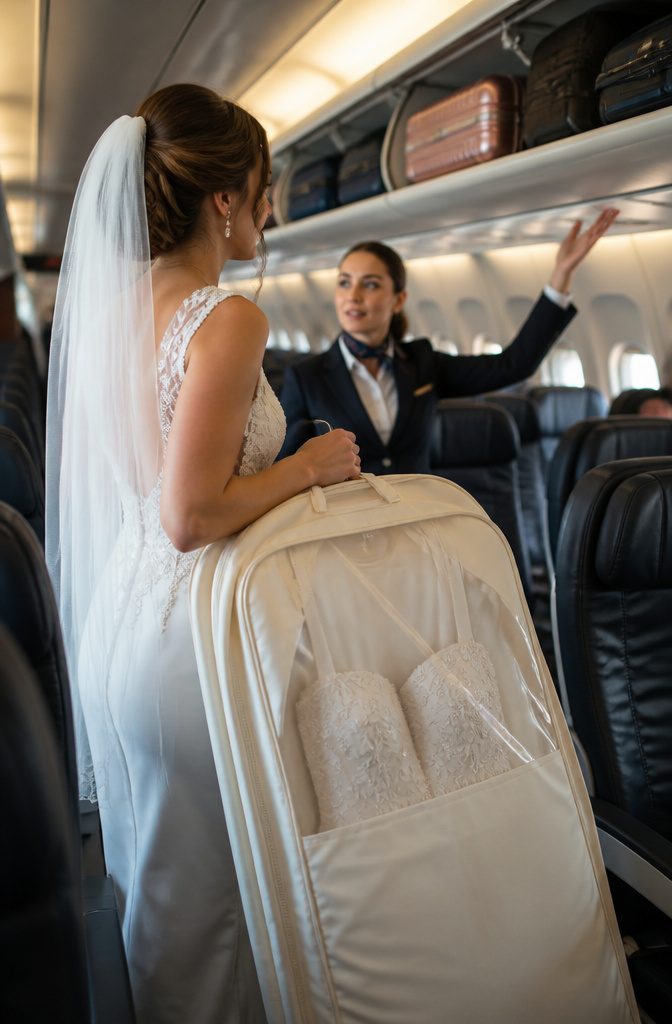
Early boarding is the only real insurance policy once you reach the gate.
A garment bag in the first overhead bin lies flat; the same bag wedged into the last available slot gets crushed. Most airlines sell priority boarding for $15–$40, and on this one item the fee pays for itself.
The forward closet is not a promise, so treat any crew member who offers it as doing you a favor.
Ask while boarding, not after takeoff, and phrase it as a question with an easy out: "If there’s any closet space, I’d love to hang this; otherwise I have the bin covered."
On a full flight the answer is usually no, and the bin becomes your only play.
I learned this the hard way on a sold-out morning flight to Chicago.
No closet, no wiggle room in Group 4 boarding. The garment bag fit lengthwise only because I had folded the train into a trifold and rolled it from the bottom, keeping the skirt slim enough to slide in flat.
The bride two rows ahead of me had not; her bag went in sideways, sticking out, and a flight attendant gate-checked it to the belly.
The dress arrived wrinkled, not ruined, but she spent her first afternoon steaming in the hotel bathroom instead of at rehearsal dinner.
Pack for the bin you are almost certain to get, not the closet you hope for.
6. Arrival: Hanging, Dropping, Steaming
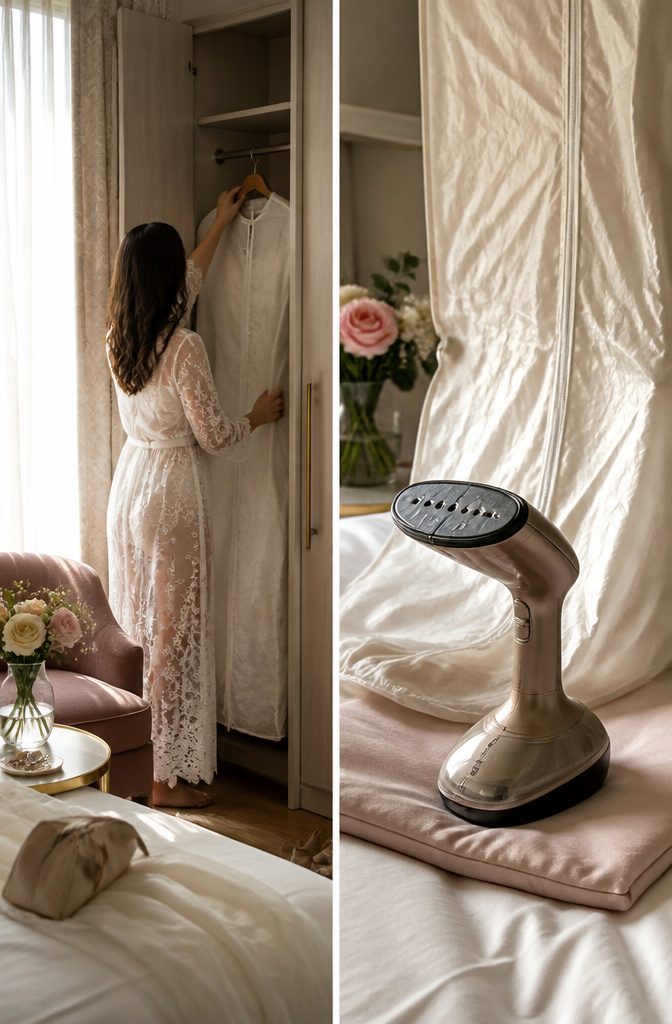
The first thing to do after clearing baggage claim is get the dress onto a hanger, full-length, in whatever closet or corner your hotel room allows.
Gravity does more than any tool in the first hour. Creases that looked permanent in the garment bag start to soften almost immediately, and the relief of watching the skirt release its folded shape is real.
Once the dress has dropped, you can see which wrinkles actually need work.
Three routes exist from here. Hotels will often send a gown out for steaming, but unless you are at a five-star property, the risk of letting the dress leave your sight outweighs the convenience.
A handheld travel steamer you packed yourself keeps control in your hands and costs nothing extra.
The third option, and the one I would lean toward for anything with delicate layers or a train, is finding a local professional: a bridal boutique that carries your brand, a seamstress, or a wedding-day dresser who steams and preps the gown on-site.
That last choice buys you someone who also handles last-minute button snags and thread pulls, which is worth the fee if your budget allows it.
7. The Emergency Kit I Pack Now
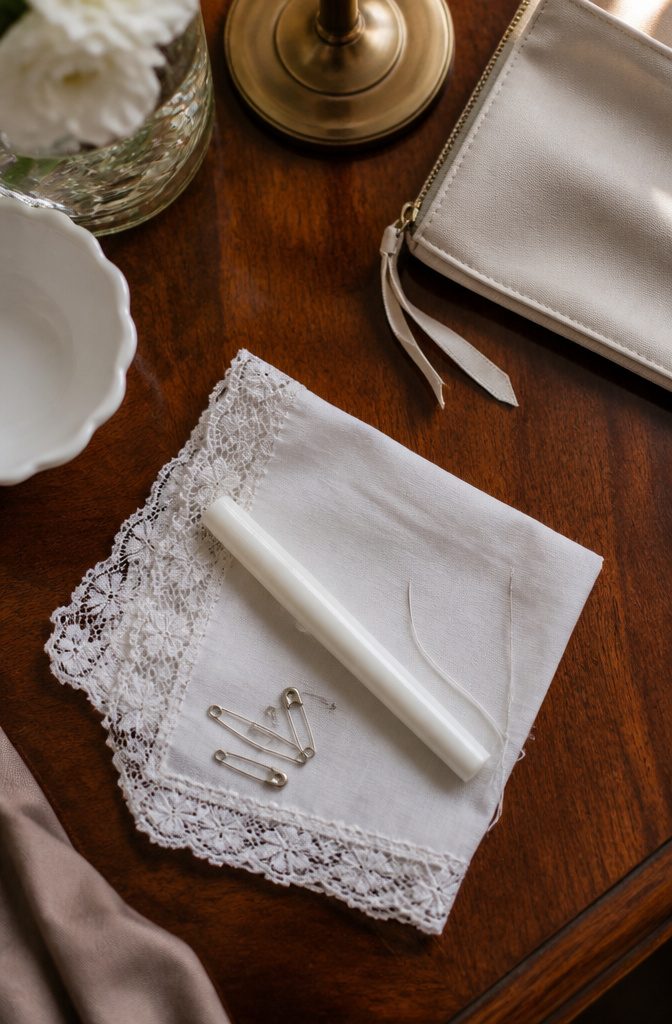
A needle with matching thread, safety pins, and a stain remover pen now live in every garment bag I pack, because each one earned its place through a morning that could have gone wrong.
The thread and needle came first: a bridesmaid stepped on the hem while the bride was still in the hotel room, and three small stitches in the lining closed the gap before anyone saw it.
Safety pins handle the things you do not have time to sew, a broken bustle loop or a strap that slips. The stain pen matters most on travel days, when coffee or makeup meets white fabric hours before the ceremony.
Sources list these with a travel steamer or wrinkle spray, but the steamer stays in checked luggage; the pen, the pins, and the needle ride in the carry-on garment bag where I can reach them.
Airline Policies Compared
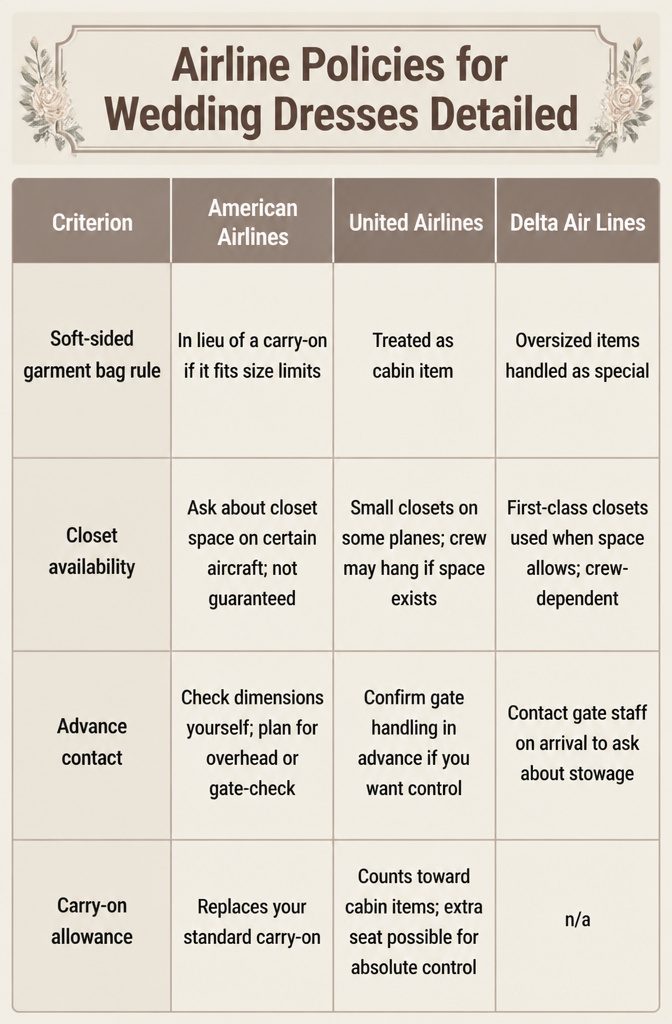
American Airlines, United, and Delta each handle wedding dresses differently, and the gap between what is written and what actually happens at the gate matters more than most brides expect.
| American Airlines | United Airlines | Delta Air Lines | |
|---|---|---|---|
| Garment bag rule | Soft-sided garment bag allowed in lieu of a carry-on if it fits size limits | Treated as cabin item; no dedicated wedding dress policy | Oversized/unique items handled as "special" at gate |
| Closet availability | Ask about closet space on certain aircraft; not guaranteed | Small closets on some planes; crew may hang if space exists | First-class closets used when space allows; crew-dependent |
| Advance contact | Check dimensions yourself; plan for overhead or gate-check | Confirm gate handling in advance if you want control | Contact gate staff on arrival to ask about stowage |
| Carry-on allowance | Replaces your standard carry-on | Counts toward cabin items; extra seat possible for absolute control | n/a |
The table looks tidy, but the real story is the word "if." None of these carriers guarantee closet space, and what one crew allows on a Tuesday flight may not repeat on Thursday.
Policies also shift by aircraft type; a regional jet has almost nowhere to put a full-length gown, while a widebody on a long-haul route sometimes offers a forward cabin coat closet.
My practical read: call the airline after booking, ask specifically about your aircraft type, and still pack for the overhead bin as your plan A. The closet is a bonus, not a strategy.
Garment Bag Types Compared
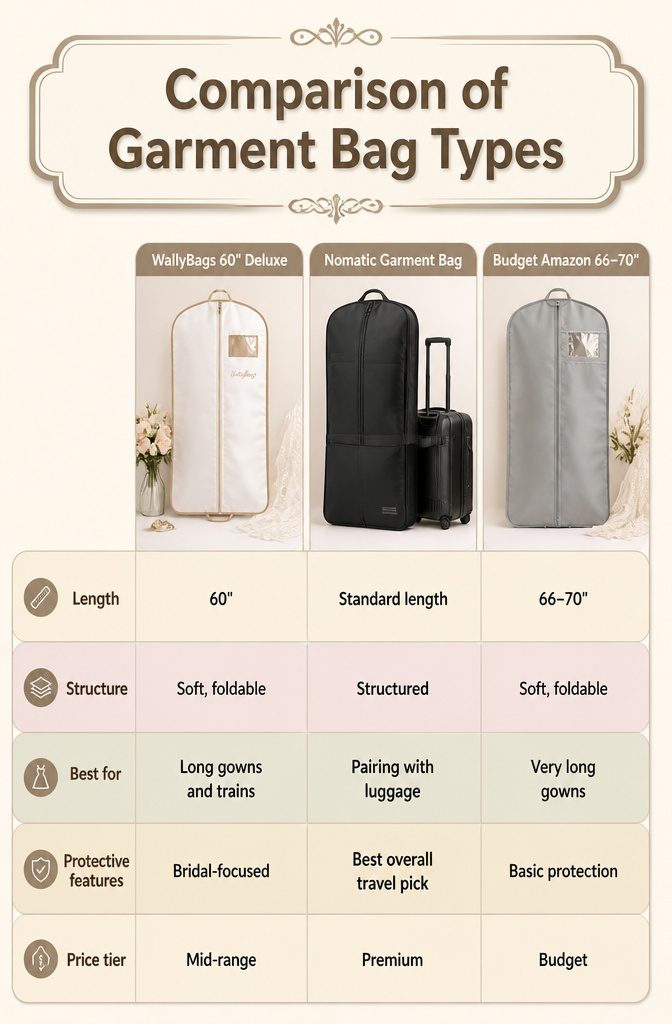
A garment bag for a wedding dress runs longer than standard carry-on suitors, and the extra inches matter more than most brides expect until they try to zip a train inside something built for a business suit.
The market splits into three tiers that handle this differently.
| Feature | WallyBags 60" Deluxe | Nomatic Garment Bag | Budget Amazon 66–70" |
|---|---|---|---|
| Length | 60" | Standard garment bag length | 66–70" |
| Structure | Soft, foldable | Structured with luggage strap | Soft, foldable |
| Best for | Long gowns and trains | Pairing with rolling luggage | Very long gowns, heavy beadwork |
| Protective features | Bridal-focused, personalization available | "Best Overall" travel pick, overhead bin friendly | Basic protection; quality varies |
| Price tier | Mid-range | Premium | Budget |
The WallyBags option sits at the bridal-industry standard of 60 inches, which covers most gowns without the bulk of the extra-long bags.
I would not trust the cheapest Amazon bags as a primary carrier; the sources treat them as backup options for a reason, and the quality gap shows up in zipper failure or torn lining under the weight of beaded fabric.
The Nomatic wins if you are already checking a rolling bag and want to strap the dress securely to that handle rather than manage a separate item through the terminal.
For a minimalist, fitted gown without a train, skip the bridal-specific length entirely and use a compact suiter; the overhead bin space you save is space you do not have to fight a flight attendant for.
Packing Techniques Compared
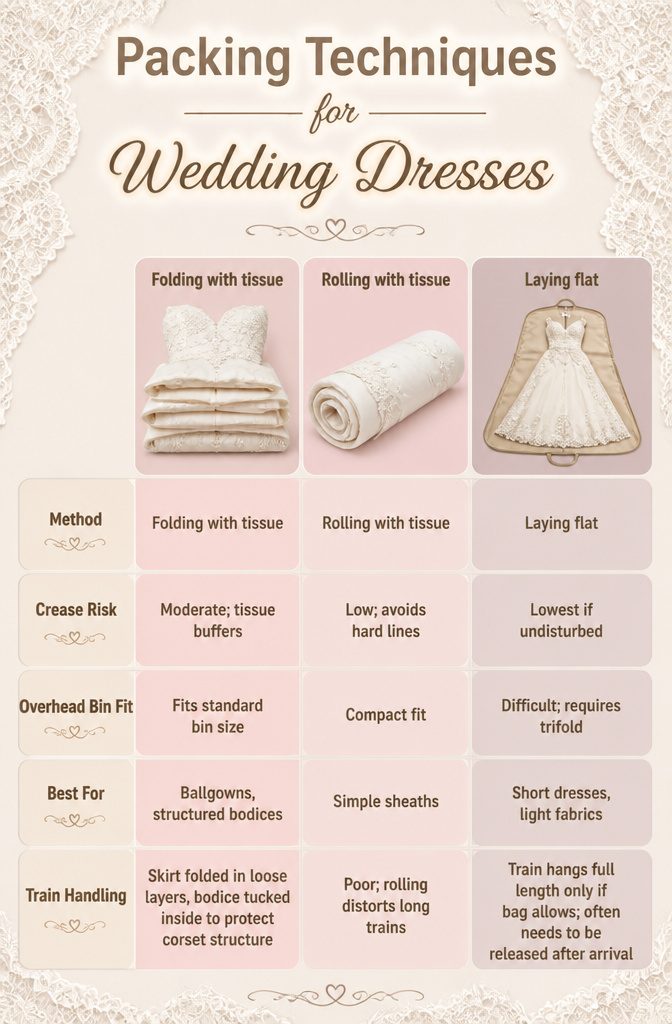
Rolling wins for sheaths, folding with tissue wins for ballgowns, and laying flat only works when the airline plays along.
Three packing methods dominate the advice for flying with a wedding dress, and the right one depends almost entirely on the dress shape and your carry-on constraints.
| Method | Crease Risk | Overhead Bin Fit | Best For | Train Handling |
|---|---|---|---|---|
| Folding with acid-free tissue | Moderate; tissue buffers fold lines | Folds to standard bin size | Ballgowns, structured bodices | Skirt folded in loose layers, bodice tucked inside to protect corset structure |
| Rolling with tissue | Low; avoids hard crease lines | Compact, flexible fit | Simple sheaths, streamlined styles | Poor; rolling distorts long trains |
| Laying flat in garment bag | Lowest if undisturbed | Difficult; requires trifold or half-fold to fit | Short dresses, light fabrics | Train hangs full length only if bag allows; often needs to be released after arrival |
The tissue between folds matters more than the fold itself.
One approach recommends steaming first, letting the gown cool completely, then layering tissue at each fold point to protect beading and embroidery. Rolling avoids crease lines entirely but only suits dresses without volume or length to compress.
Laying flat sounds ideal until you try fitting a full-length garment bag into an overhead bin; most require at least a loose trifold, which reintroduces fold points you then hope gravity fixes at the hotel.
Frequently Asked Questions
What is the best way to pack a wedding dress for a flight?
Fold it with acid-free tissue between each layer of skirt, bodice, and train so the fabric never presses against itself.
Rolling works only for simple sheaths without volume; a ballgown’s structure warps when rolled and sets wrinkles deep. Lay the skirt in loose accordion folds, tuck the bodice inside to keep the corset upright, and slip tissue at every bend.
Can I check my wedding dress as luggage?
No. Carry it on as your personal item or carry-on; a soft-sided garment bag counts as your carry-on allowance on airlines like American if it meets size limits.
Checked luggage risks misplacement, damage, or routing onto the wrong aircraft, and no airline guarantees closet space even in premium cabins.
What should I do if my dress gets wrinkled during travel?
Hang it full-length immediately at your destination and let gravity work for an hour before touching it with any tool.
Pack a handheld travel steamer for wrinkles that remain, or arrange a local professional steaming through a bridal boutique or wedding-day dresser if your gown has delicate layers or a train.