
A friend who marries you costs roughly $20 to $40 in ordination fees, plus travel, lodging, and a thank-you gift comparable to your wedding party’s. The gap between that and a professional’s $300 to $800 fee is narrower than couples expect, and the real expense is the stress of managing someone untested at speaking to fifty pairs of eyes. The stage most people get wrong is not the ask itself; it is checking whether that friend can legally officiate where your venue actually sits, since some counties reject online ordination certificates that the next county over accepts.
1. Pick Someone Who Can Actually Do the Job

The people who spring to mind first are usually the right place to start. I picture my own list: the college roommate who gave the toast at my engagement party, the aunt who never misses a birthday, the mentor who met us both. Love is not the only filter, though, and this is where I have seen couples stumble.
Two qualities are non-negotiable. Comfort speaking in front of a crowd matters because even a small wedding gathers forty or fifty pairs of eyes at the moment that counts. A shy uncle who adores you both may freeze at that number, and the silence while he finds his voice is not the pause anyone wants. Reliability matters just as much. The officiant signs the marriage license after the ceremony and must submit it to the county clerk, typically within 3–10 days depending on the state. Miss that window and the beautiful ritual you planned does not create a legal marriage.
Personality shapes the ceremony itself. A close friend who knows your story brings warmth no stranger matches. A family member can speak to both sides of the aisle in a single sentence. The name on that license stays forever, and the face beside you in photos does too. Choose someone whose presence adds steadiness, not weight.
2. Check If They Can Legally Officiate Where You Are Marrying
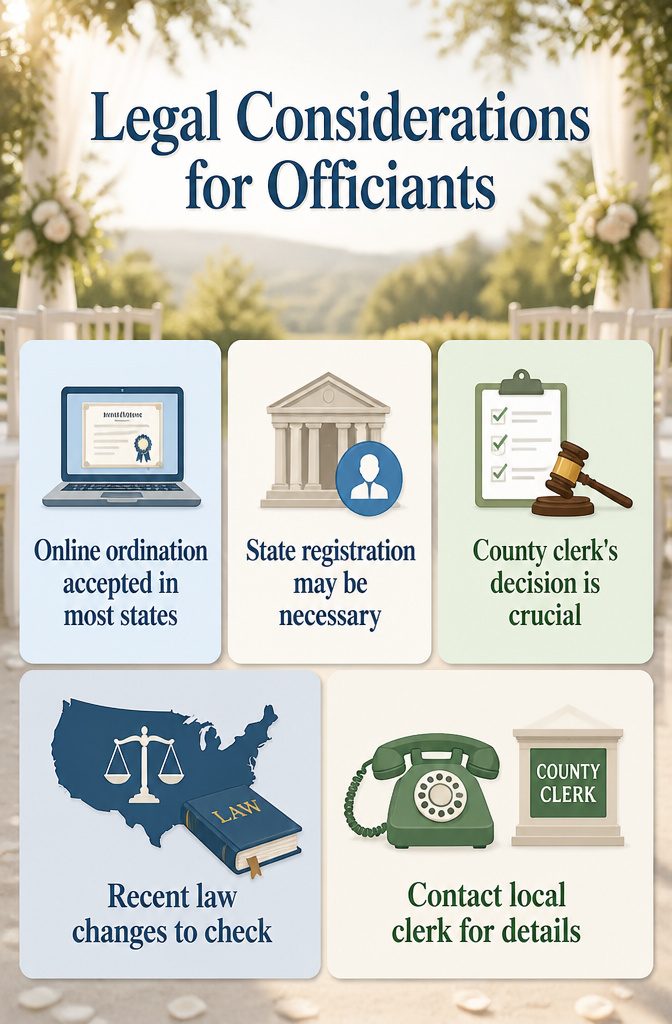
Online ordination through the Universal Life Church or American Marriage Ministries works in most states, but the rules shift once you cross a state line. Some states let your friend get ordained in an afternoon; others demand that they register in person at a government office before the ceremony. A few make it genuinely hard for a lay officiant to marry you at all.
Check this before you ask, not after. Nothing stings like a friend saying yes, then finding out they cannot legally perform the ceremony where your venue sits.
State law is only the starting point. County clerks interpret those rules their own way, and their word is what matters when your license gets filed. One county may accept a printed certificate from an online ordination; the next county over may reject it. A two-minute phone call to the clerk’s office where you are marrying saves you from that surprise.
Tennessee recently tightened its laws and cut back on who can officiate. New York City requires in-person registration at the clerk’s office. Virginia limits officiants to pastors of recognized churches in some readings. The American Marriage Ministries website keeps a current state-by-state guide that is worth checking, but confirming with your specific county clerk is the step too many couples skip.
3. Plan the Ask Before You Make It
The tone you set matters more than the exact words. A sarcastic line about "promoting" your college roommate from guest to staff lands beautifully with someone who shares your humor and already knows you are serious, but the same joke can make a sibling feel cornered. Match the approach to the relationship.
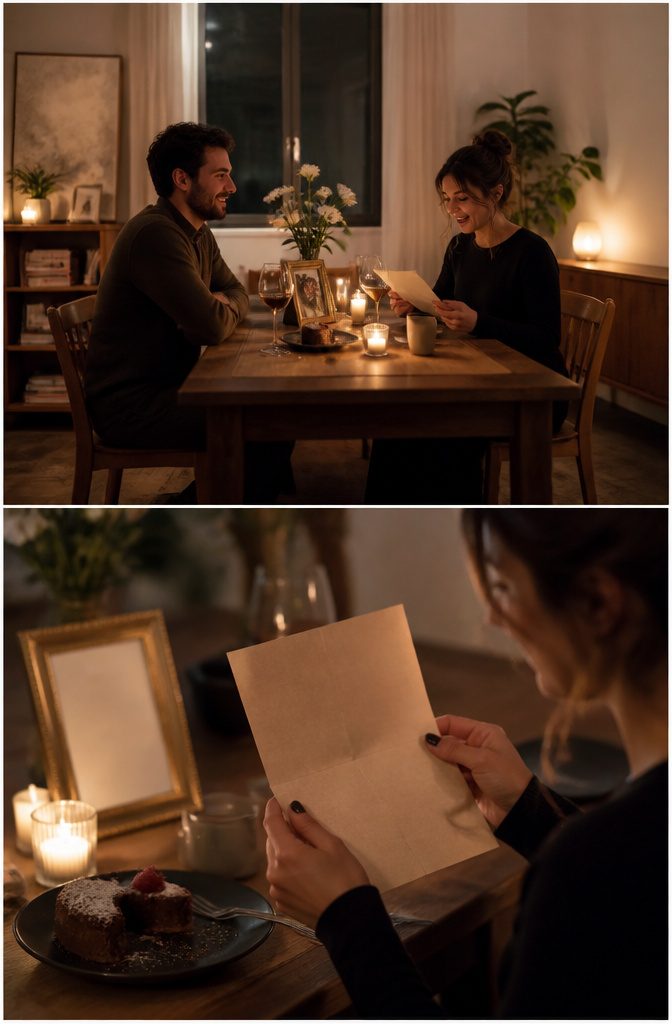
If the ask happens in person, pick a location that means something to both of you. A quiet dinner where you first introduced your partner, or a walk through the park where you used to decompress together, signals that this request is personal, not transactional. For someone who processes slowly or lives far away, a handwritten letter gives them space to sit with the question before answering.
Cover any ordination fees and travel costs without making them ask. These expenses are yours to carry, not theirs to absorb as the price of friendship. Beyond that, plan a meaningful gift comparable to what your wedding party receives; officiating demands time, emotional energy, and public responsibility that deserves recognition.
The goal is making them feel honored, not trapped. Give them room to say yes honestly, not out of panic or flattery, and mean it when you tell them no pressure at all.
4. Ask Clearly and Give Them Room to Say No

The actual conversation matters more than the script you rehearse in your head. I learned that the hard way when a friend of mine accepted an officiant role she didn’t want, then spent six months dreading the ceremony while pretending excitement every time we talked wedding. She felt trapped because I’d framed it as "we can’t imagine anyone else up there," which sounded like love but functioned like pressure.
Now I tell couples to ask early and ask honestly. Around the same time you’re assembling your wedding party works well. That gives your person space to get ordained if they need to, check whether your county requires registration beyond ordination, and actually write something worth hearing. Springing this on someone a month out forces them to choose between disappointing you or stepping into a role they haven’t prepared for.
Lead with why they matter to you, then get concrete about what you’re asking. The ceremony itself is only part of it. There’s the rehearsal, usually the night before. There’s filing the marriage license correctly and on time. There’s writing or at least shaping the script, which takes more hours than most people guess. If your state requires a witness or notarization for the license, they may need to handle that too.
The exit ramp is as important as the invitation. Some people simply hate public speaking. Others don’t want the weight of your legal paperwork on their shoulders. Saying "we would love this, and we completely understand if it’s not for you" isn’t hedging your bet; it’s protecting the friendship. Someone who accepts freely will bring more warmth to your ceremony than someone who couldn’t figure out how to decline.
5. Walk Them Through the Ceremony They Will Lead
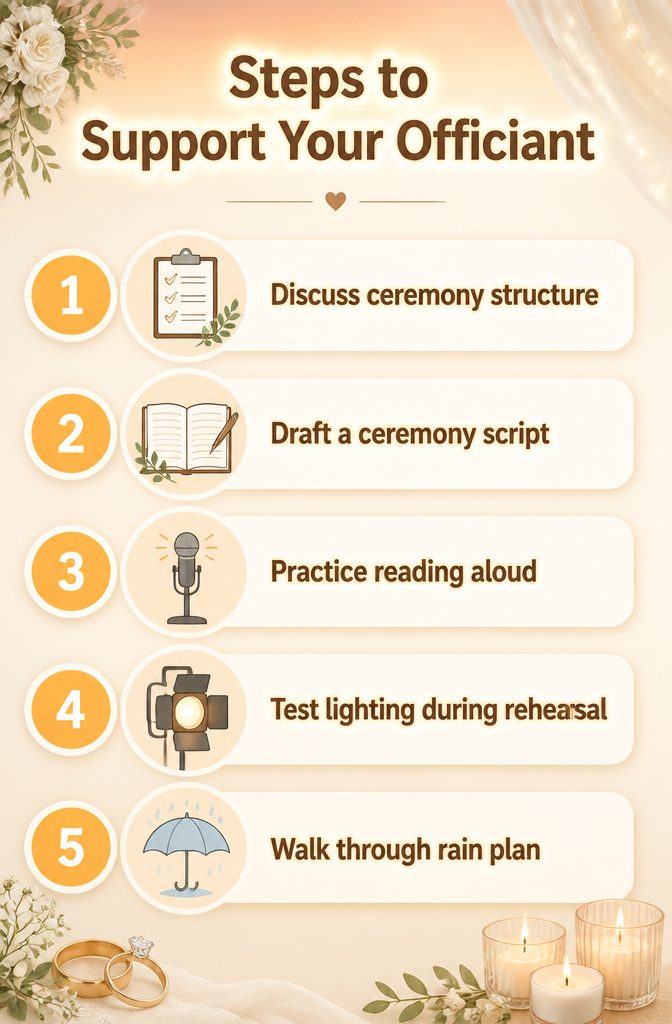
Most first-time officiants have never led a ceremony before, so offering resources and hands-on support is expected, not optional. I start by walking mine through the full structure: the processional order, how long each reading should run, where to stand during the ring exchange, and what happens if the microphone cuts out or a ring goes missing. A ceremony script drafted early gives them something concrete to read and revise, whether they write their own portion or deliver what we wrote together. The script has to work spoken aloud, not just on paper, so I schedule at least one practice run where they read every word in full voice. Hosting that rehearsal at the same time of day as the ceremony also lets us test the lighting and shadows, indoors or out, so no one ends up half-lit in the photos. If there is a rain plan, we walk that location too, lights on, so the pivot feels familiar rather than frantic.
6. Set Them Up to Succeed on the Day

The morning of my sister’s wedding, her college roommate officiant woke up with a 103-degree fever. The couple had never named a backup, so the planner spent two hours calling every professional in the county while the bride did her makeup through tears. A printed script in the officiant’s hands, a microphone checked at rehearsal, and a designated license handler would not have prevented the illness, but the absence of a Plan B nearly prevented the ceremony.
Most states give your officiant a narrow window, typically 3–10 days, to file the signed license with the county clerk. A signed license that never gets filed means you are not legally married, no matter how beautiful the vows were. I put the license in a labeled envelope with the clerk’s address pre-printed, then asked my aunt, who lives near the courthouse, to be the one who actually takes it in. The officiant’s job is to sign; someone else’s job is to make sure it arrives.
Covering your friend’s travel and lodging upfront is the real payment. A token gift after the ceremony, a nice bottle or a handwritten note, simply closes the loop on a favor that cost them time and nerves.
What It Costs to Have a Friend Officiate
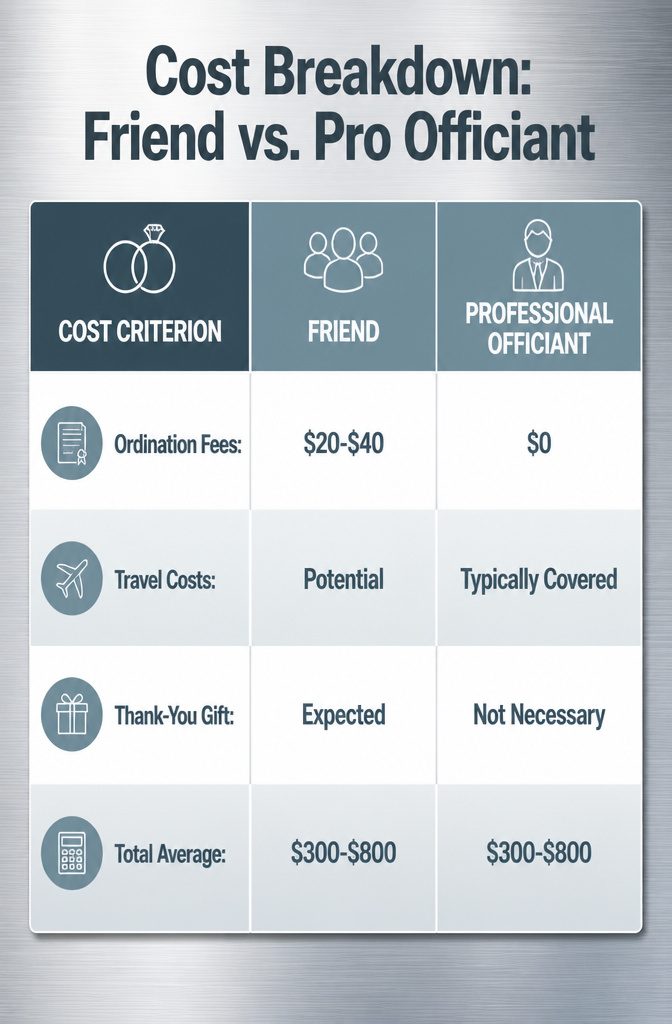
The friend who marries you is not your free option. Ordination through an online organization like the Universal Life Church or American Marriage Ministries usually runs $20–40, and some states or counties tack on a separate registration fee that can require an in-person visit. Travel and lodging land on your plate if they are coming from out of town, and the thank-you gift should match what you are giving your wedding party at minimum. Add it up and you are still likely under the $300–800 a professional officiant charges, but the gap is narrower than couples expect. Where people get caught is assuming the role is pure sentiment and skipping the money conversation until a week out, when resentment has already built.
How a Friend Officiant Compares to Hiring a Pro
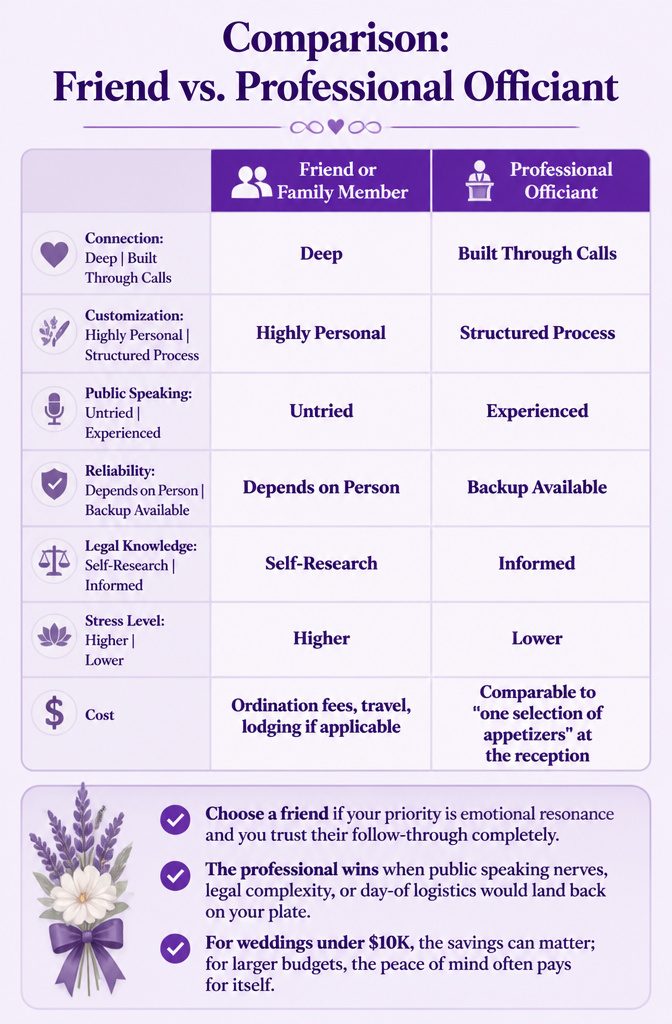
A friend who knows you both can bring warmth to the ceremony that no stranger matches. The trade-off is what you give up for that intimacy.
| Friend or Family Member | Professional Officiant | |
|---|---|---|
| Personal connection | Deep; knows your story firsthand | Built through questionnaires and calls |
| Ceremony customization | Highly personal, but writing quality varies | Structured process with creative input |
| Comfort with public speaking | Often untested at this scale | Handles hundreds of guests routinely |
| Reliability and follow-through | Depends on the person; no backup built in | Backup officiants available if illness strikes |
| Legal knowledge | Must research state and county rules themselves | Already knows local requirements |
| Stress level for couple | Higher; you may end up managing them | Lower; they coordinate with vendors and planners |
| Cost | Ordination fees, travel, lodging if applicable | Comparable to "one selection of appetizers" at the reception |
Choose a friend if your priority is emotional resonance and you trust their follow-through completely. The professional wins when public speaking nerves, legal complexity, or day-of logistics would land back on your plate. For weddings under $10K, the savings can matter; for larger budgets, the peace of mind often pays for itself.
Questions Couples Forget to Ask
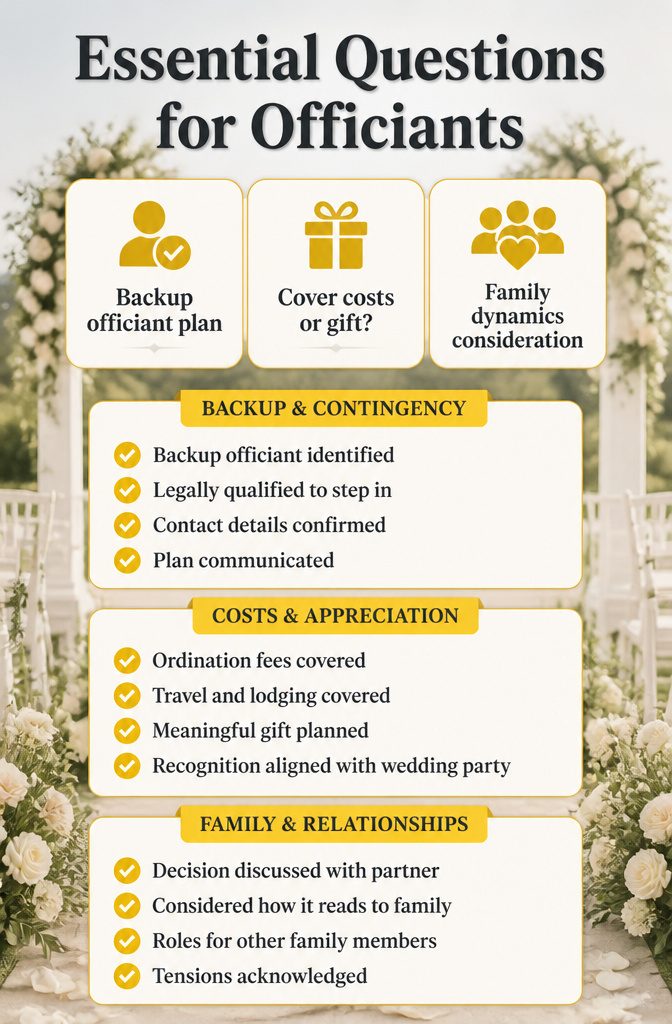
A few practical questions slip through the cracks when couples are caught up in the excitement of asking someone close to them. Covering these early keeps the day from turning complicated.
- What happens if they cannot make it? Life intervenes: illness, work emergencies, travel disruptions. Naming a backup officiant, even informally, keeps the ceremony from scrambling for a replacement an hour before it starts. A second choice who is already ordained or legally qualified to step in is the safer move.
- Are you covering costs, giving a gift, or both? Ordination fees, travel, and lodging are typically the couple’s responsibility. Beyond that, a meaningful gift comparable to what the wedding party receives is the standard way to recognize the time and emotional weight of the role. One or the other alone can leave the gesture feeling lopsided.
- How does this read to the rest of the family? Choosing an officiant from one side when tensions already exist can quietly signal allegiance in a way nobody intends. Talking through the decision with your partner about how it will land, and giving the other family meaningful roles elsewhere in the ceremony, usually softens the edge without making the ask feel smaller.
Frequently Asked Questions
How do I ask someone to officiate my wedding?
Ask early, around the time you assemble your wedding party, so they have months to prepare. Lead with why they matter to you, then be specific about the rehearsal, writing the script, and filing the marriage license. End with a genuine exit ramp: tell them you completely understand if the role is not for them.
What are the legal requirements for someone to officiate a wedding?
Rules vary by state and often by county within the state. Online ordination through the Universal Life Church or American Marriage Ministries works in most places, but some states require in-person registration at a clerk’s office and a few make lay officiants difficult to use at all. Call the county clerk where your venue sits to confirm their specific rules before you ask anyone.
How should I prepare my officiant for the role?
Walk them through the full ceremony structure, give them a draft script early, and schedule at least one practice run where they read every word aloud. Rehearse at the same time of day as the ceremony to test lighting, and walk the rain plan location too if you have one.
Should I cover costs for my officiant?
Yes. Pay ordination fees and any travel or lodging costs without making them ask. A meaningful gift comparable to what your wedding party receives is also standard, since officiating demands significant time, emotional energy, and public responsibility.
What if my chosen officiant can’t make it?
Name a backup officiant who is already ordained or legally qualified to step in. The morning-of scramble to find a replacement can derail hours of careful planning, so confirm this person in advance and make sure they have the script too.