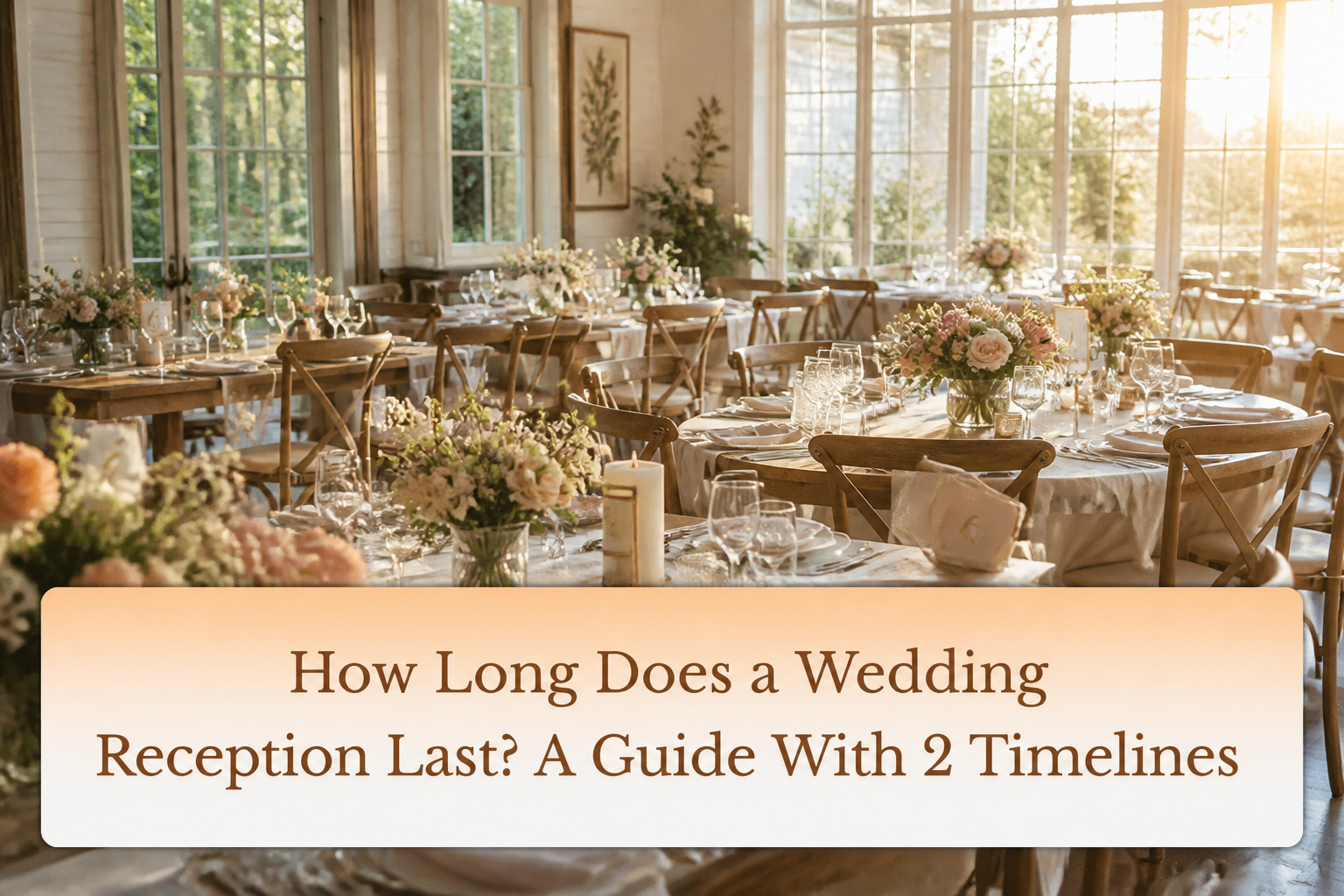
A standard wedding reception lasts 4 to 6 hours, with 5 hours being the figure most planners and venues settle on. That single hour of difference matters more than couples expect when they first start booking. I learned this the hard way at a friend’s wedding where the reception clocked in at just over four hours: the cocktail hour felt generous, dinner dragged with toasts running long, and by the time the dancing started, guests were already checking their phones for rides.
How Long a Wedding Reception Lasts
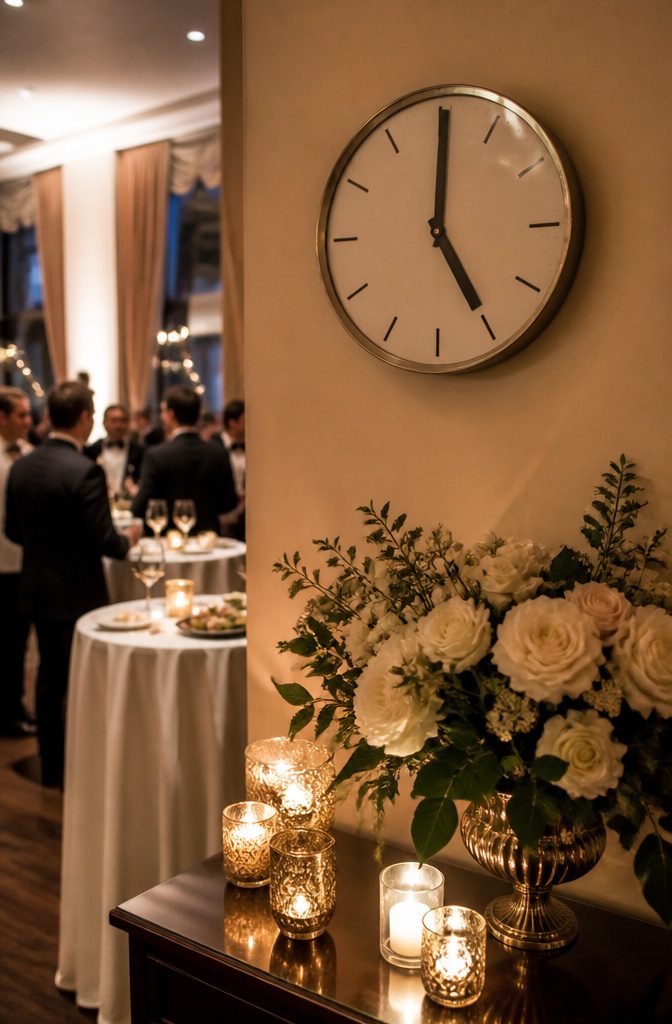
Most wedding receptions run 4 to 6 hours, with 5 hours being the number most planners and venues settle on. That single hour of difference matters more than couples expect when they first start booking.
I learned this the hard way at a friend’s wedding where the reception clocked in at just over four hours. The cocktail hour felt generous, dinner dragged slightly with toasts running long, and by the time the dancing started, guests were already checking their phones for rides. Two hours of dancing sounds right on paper, but in practice the floor never fully filled before the last song.
Five hours splits cleanly: one hour for cocktails, two for dinner and toasts, two for dancing. Six can work if you know your crowd has the stamina, but past that point the energy thins and the room empties before the DJ plays out. Four suits a casual, cocktail-style celebration where guests mingle more than they dance, though a formal seated dinner at that length feels rushed.
The number you commit to drives everything that follows. Vendors price by the hour, and guests set their internal clock by the invitation. Lock the duration early, and the rest of the timeline falls into place.
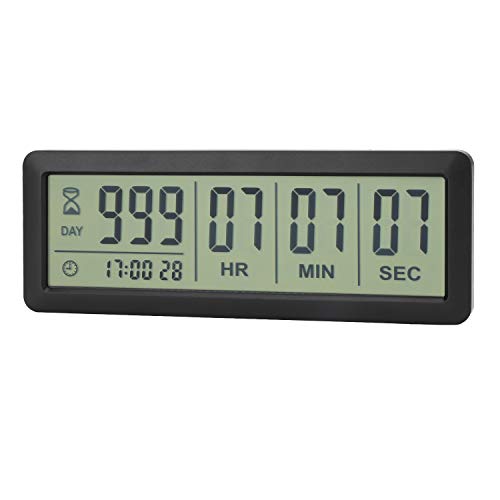
✔️999-Day Countdown Timer for Life’s Big Moments - Counts down (or up) up to 999 days, 23 hours, 59 minutes, and 59 seconds—perfect for retirement countdown clock, vacation countdown timer, wedding countdown, pregnancy due date tracker, or any long-term event countdown. Sounds a 60-second alert when time’s up.

FUN GIFT Wedding Countdown Clock: Great Bridal Shower Gift to a Friend or Coworker They'll Love it
The Cocktail Hour
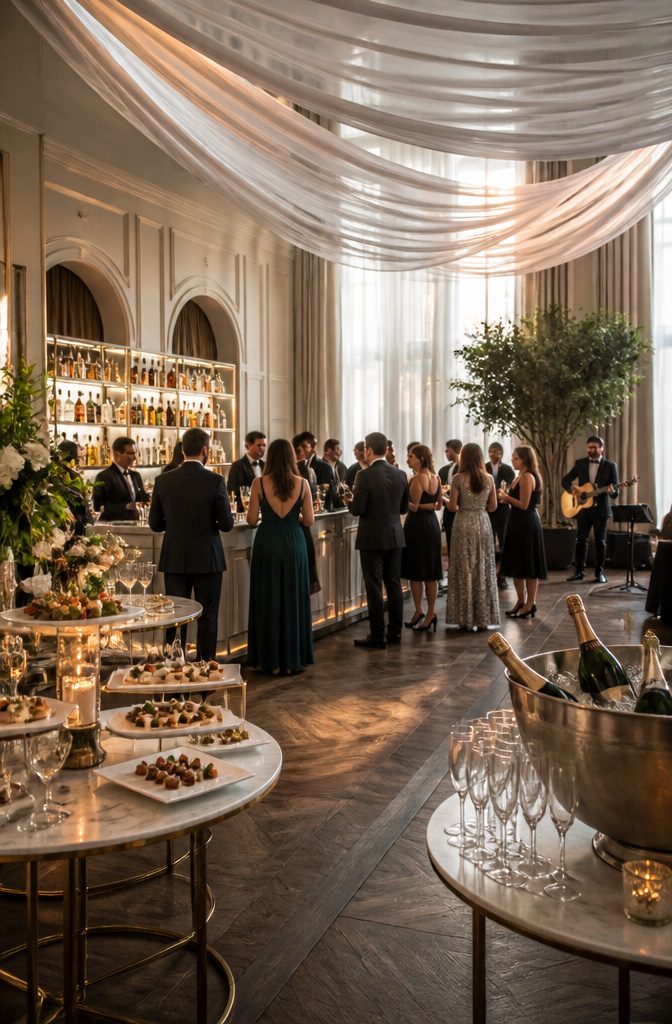
The cocktail hour is the hinge between ceremony and dinner, and 60 minutes is the standard that keeps the evening on its feet. Guests arrive with fresh energy, grab a drink, pick at hors d’oeuvres, and start conversations they will carry through the night. The couple usually slips away for portraits, and soft music or a live musician keeps the room from feeling empty.
Stretch that hour to 90 minutes and the mood shifts. I have watched the open bar do its work while dinner waits: guests get too loose too early, or they get hungry and the room turns restless. The energy that should peak on the dance floor gets spent standing around. One planner I follow puts it plainly: the hazy look sets in before the chicken breast arrives.
Keep the bar open but keep it moving. Light bites matter more than elaborate ones here; they are a bridge, not a meal. If the photo session runs long, guests pay the price, so budget your portrait time inside that single hour. The cocktail hour sets the pace for everything that follows. Let it run short and sharp.

5 IN 1 DJ Lights Bar - Telbum PartyBar combining rotating disco ball light, colorful par light, red & green pattern light, black light and white LED strobe light. A variety of beautiful colors and patterns can be presented at the same time in auto mode to help you set up a fabulous party or gig. (Using the remote control, you can specify any of the effects to play independently.)

Make Your Party More Dazzling: NEQUARE Party Lights add a magical charm to your party with updated colorful bulbs, 3 sound-activated modes, 7 lighting modes, flash and rotation speed control, and flicker speed control, allowing you to easily switch between lighting themes and create a colorful party atmosphere.

Multi-functional Sound Activated Party Lights: 3 sound-activated modes + 7 lighting effects + rotating speed control. The sensitive voice activation captures nearby sounds or music, allowing the lights to change color and speed with the beat.
Dinner and Speeches
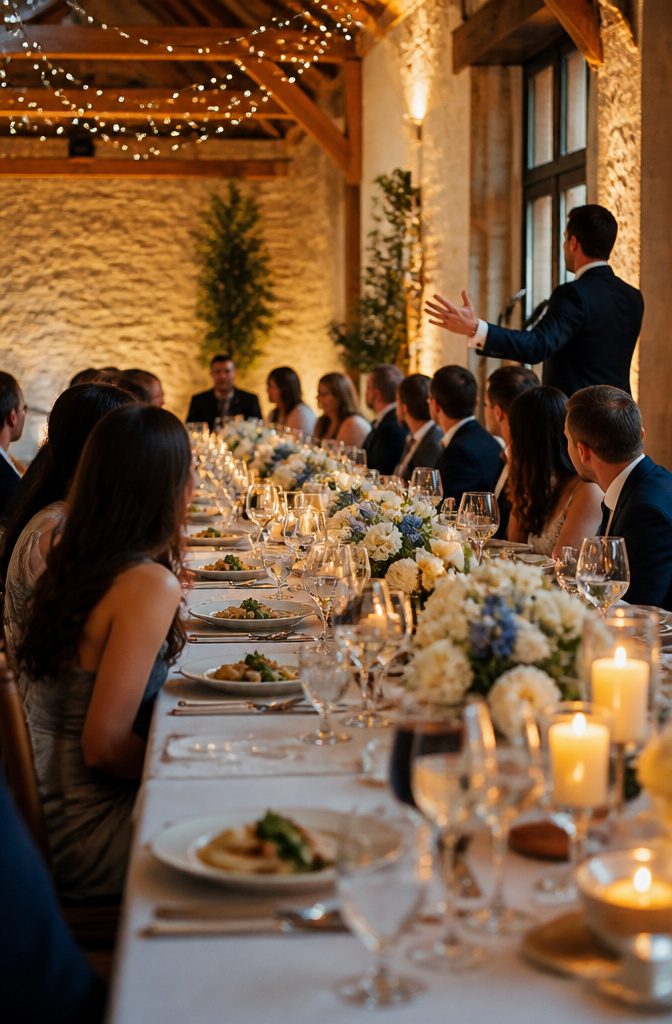
Plated service keeps dinner and speeches to about 90 minutes, while a buffet almost always pushes the full block toward two hours. Guests move through a buffet line at different speeds, and someone always lingers over the salad station or doubles back for rolls.
I build in a 15-minute buffer by telling speakers their hard stop is five minutes and meaning it. One toast that runs ten minutes over doesn’t just steal time; it steals energy from the room. If speeches finish early, the band starts early. If they run long, the dancing still starts on schedule, because I already shaved that buffer from the meal service, not from the party.

Featuring a Rose Gold theme with "Mr and Mrs, Welcome to Our Beginning" imprinted with rose gold foil. Real rose gold foil design that shines in the light, these napkins will definitely enhance your table and impress your guests.


Mini Forks: Our tiny silver plastic forks accent any dish with ease. Our mini forks for appetizers are also the perfect addition to dessert cups, food samples, catered dishes, and more!
Cake Cutting
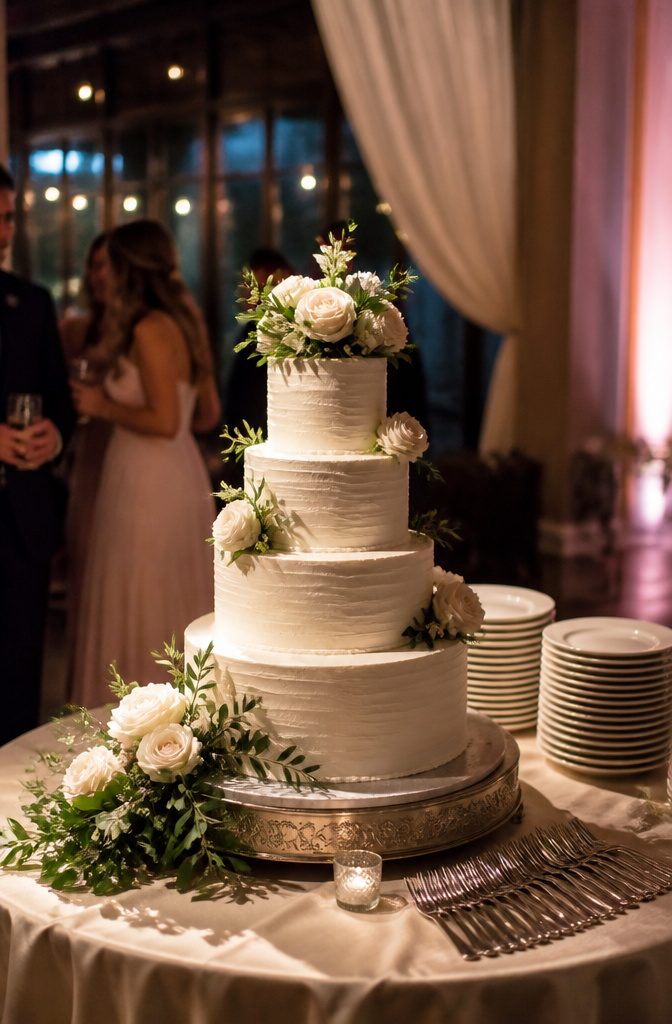
The cake cutting is a ten- to fifteen-minute window that quietly reroutes the whole evening. Servers can begin slicing while guests shift from seated conversation toward the dance floor, and your photographer gets a clean, lit shot that rarely happens once the lights drop.
One timeline I studied placed the cut at 8:30 p.m. in a ten-hour evening, with cake served by 8:45 and the floor open again before 9:00. That spacing matters. Too early and you interrupt dinner; too late and the energy you built dissipates while guests wait.
I watched a couple push theirs past 9:30, thinking the dancing would keep everyone warm. By then half the room had hit the open bar hard, sat through toasts, and started checking phones for rides. The cake came out to a thinned crowd, and the photos showed it. The ones who stayed were kind, but kindness does not fill a dance floor.
If your DJ plays something brief and playful, the moment registers even for guests not watching directly. Afterward, the signal is clear: dessert is handled, and the next phase is theirs.

This clock can be personalized with your own wording!

Easy to See: Designed with big numerals by AKCISOT.

Easy to See: Designed with big numerals by AKCISOT.
Dancing
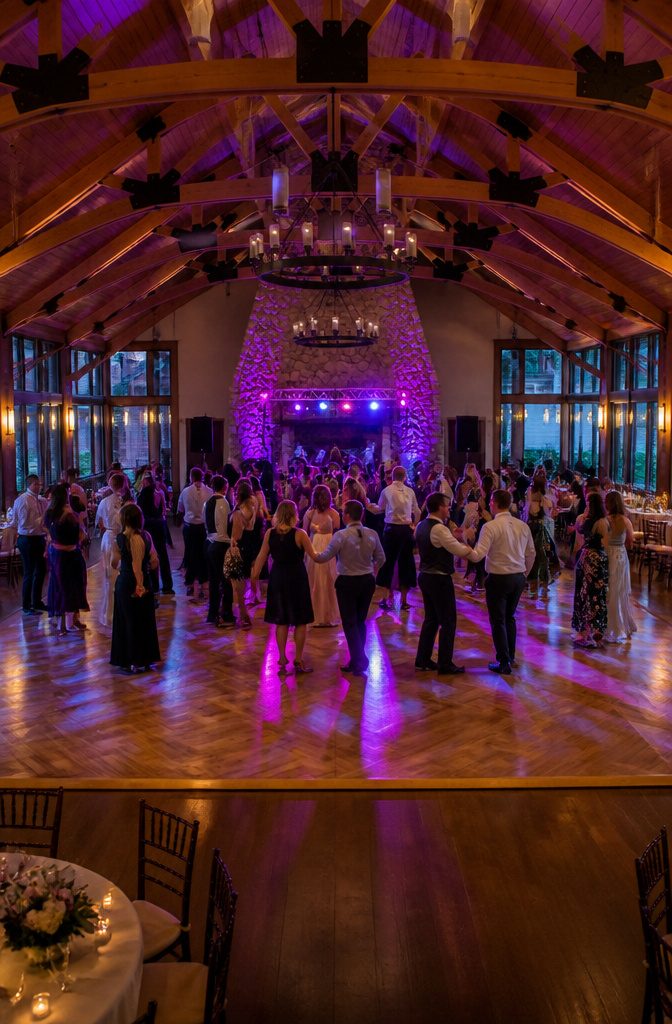
The real work of a reception happens in the two to three hours the floor is open. That window is where the DJ earns their fee, stacking the best tracks tight enough that guests never drift toward the exits. Stretch it longer and the energy curve flips: the same friends who begged for one more song at hour two are slumped in chairs by hour four, waiting for teardown to start.
Reading the room starts with the bridal party. Once they hit the floor, the ice breaks faster than any announcement from the microphone. A good DJ balances the uptempo stuff with a slow dance now and then, and slips in the bouquet or garter toss before the crowd thins.
Late-night snacks land in this same stretch, not after it. Mini sliders or fries served around the two-hour mark refuel the people still moving. Drop them too late and you are feeding the holdouts while the floor empties. The real finish line is the one you choose: end at five hours total and the last song still has a crowd, or push past six and watch the whimper.


✔️QUALITY UPGRADED LONG SETTING COUNTDOWN TIME: You can set up to 999 days, 23 hours, 59 minutes and 59 seconds. It will alarm for sixty seconds when arriving at your setting number.

🎁 [The Ultimate Countdown Timer – Better, More Customizable, and Designed with Care] Our timer is uniquely enhanced with beautifully designed, dog-themed plates that add a touch of charm and personality. Count down to moments that matter – up to 9999 days (more than 27 years)! When the big day arrives, an alarm will sound your special moment.
Late-Night Snacks and Farewell
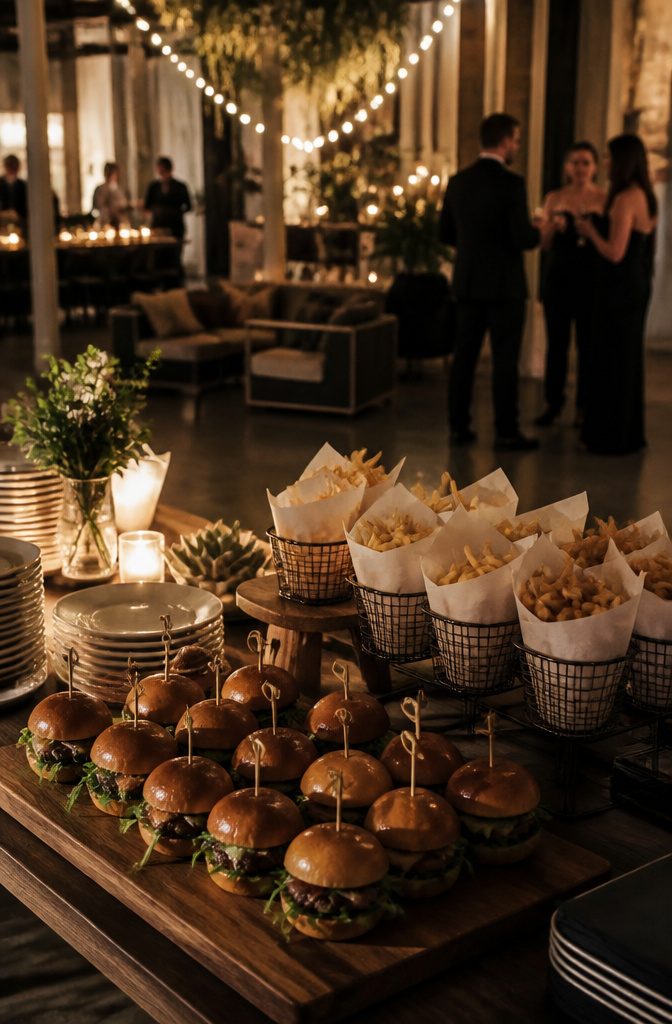
The last half-hour of a reception is where budget meets reality in sharp relief. A 20 to 30 minute wind-down with late-night snacks works when your crowd has reason to stay: out-of-town guests with hotel bars already closed, or a younger group that treats 10 p.m. as mid-evening. Mini sliders, fries, or breakfast bites keep the few remaining dancers fueled without demanding a full service.
I have watched this stretch a five-hour reception to five and a half hours without a single guest checking their watch. The trick is reading the room. When half the chairs are empty by 9:30 p.m., those snacks become money spent on air and crumbs. A sparkler exit or confetti toss only lands if bodies remain to line the path; otherwise you are staging a farewell for your photographer and your parents.
Venue noise ordinances often decide this for you. Some halls in harder-regulated areas cut amplification at a fixed hour, which turns your wind-down into whispered conversation and phone-light dancing. Plan the snack service before that cutoff, or skip it entirely and let people drift toward cars while the night still feels full.

【Disco Ball Party Lights】The party light consists of a multi-color disco ball light, a multi-color ocean light, two disco pattern lights, and a star light. Lighting Colorful and rich, it is definitely the lighting combination you want and like. Can bring a perfect lighting feast to your parties.

🔹 150W Multi Effects Moving Head Light: Beam, Mirror 3D, Magic Ball, Starfield, Strobe - Plug & Play Merge 6‑arm moving beams, magic ball scatter, LED ring glow, Mirror 3D effects, red‑green star effect, and white‑amber dual strobe in one effortless fixture. Replaces 4+ traditional party lights - just one cable, one stand. Cuts typical mobile rig setup from hours to barely couple mins. Sound‑driven modes pulse to the beat instantly, and the powerful 150W output fills an entire garage or small hall.
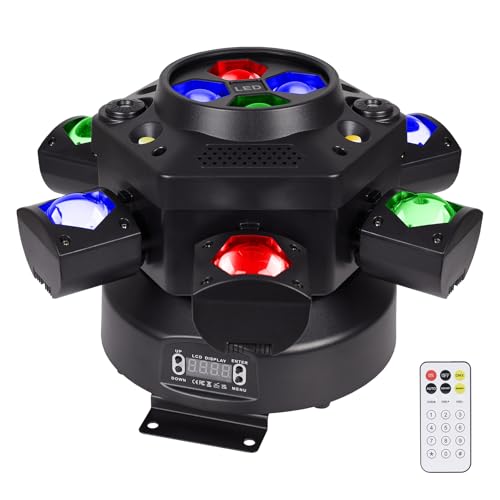
【TURN ANY SPACE INTO A CARNIVAL PARTY】DJ moving head light with 6-arm beams, bee-eye effect, red-green starlight, and white & amber strobes, this versatile LED DJ light instantly creates the ultimate party vibe—perfect for family gatherings, birthdays, and epic house parties.
A 5-Hour Timeline That Works
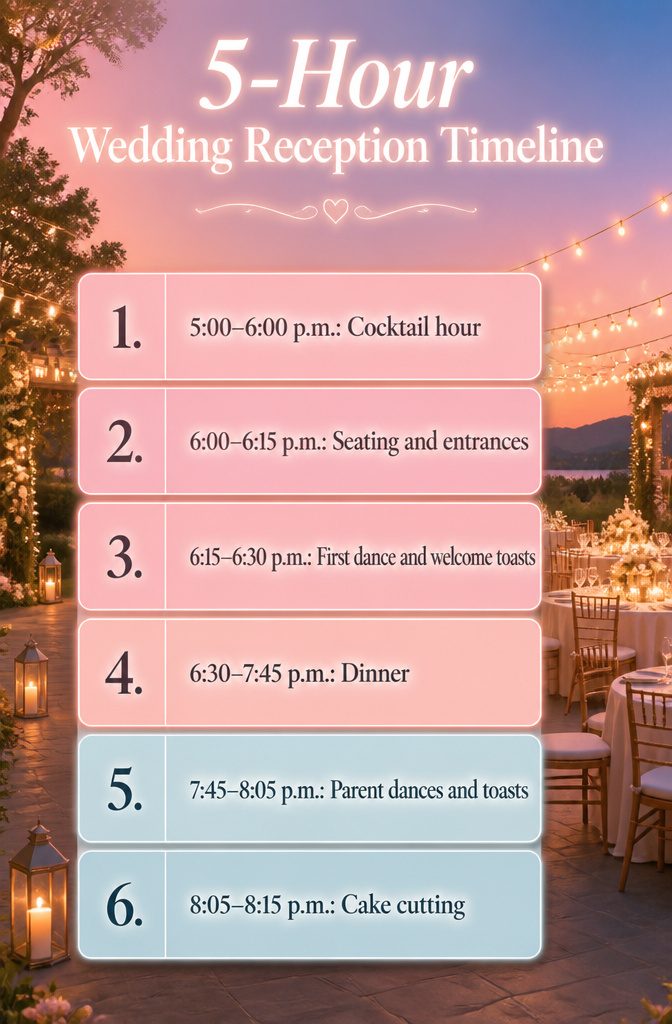
A 5-hour reception from 5:00 p.m. to 10:30 p.m. gives you the full arc most guests expect without the bill climbing into six-hour territory.
- 5:00–6:00 p.m.: Cocktail hour. Guests drink and eat hors d’oeuvres while you finish portraits. If photos run fifteen minutes over, nobody notices; the bar keeps them occupied.
- 6:00–6:15 p.m.: Seating and entrances. Wedding party introductions, then your grand entrance. This is the hardest block to delay, since seated guests wait. Keep it tight.
- 6:15–6:30 p.m.: First dance and welcome toasts. One dance, two brief speeches. Longer toasts belong later.
- 6:30–7:45 p.m.: Dinner. Plated service needs the full window; buffet or family-style can shave fifteen minutes. Use that buffer if cocktail hour slipped.
- 7:45–8:05 p.m.: Parent dances and toasts. Emotional moments that also reset the room from dinner to party.
- 8:05–8:15 p.m.: Cake cutting. Signals dessert is coming and gives non-dancers something to watch.
- 8:15–9:45 p.m.: Open dancing. Ninety minutes is the sweet spot. Energy peaks around 9:00; by 9:45, you’ll feel it taper.
- 9:45–10:00 p.m.: Late-night snacks and farewell. Mini sliders or fries refuel whoever’s left. Sparkler exit, confetti toss, or a simple goodbye at the door, done by 10:00.
10:00–10:30 p.m. is your flex zone. If dinner ran long or the dance floor stayed packed, you absorb it here without cutting anything essential.

STYLISH SILVER ACCENT: Each 4.7-inch bamboo pick is topped with a polished silver bead, providing a clean, modern aesthetic that instantly elevates your appetizers and cocktails.

Pack of 200: You will get 50pcs 5 oz mini dessert cups and 50pcs plastic spoons, great catering supplies for home or restaurant use

Unique Eclectic Design Collection - Set of 6 intricately detailed stainless steel cocktail picks featuring Bear, Skull, Owl, Pineapple, Octopus, and Elephant. These conversation-starting skewers add personality and fun to any drink.
What Changes the Length
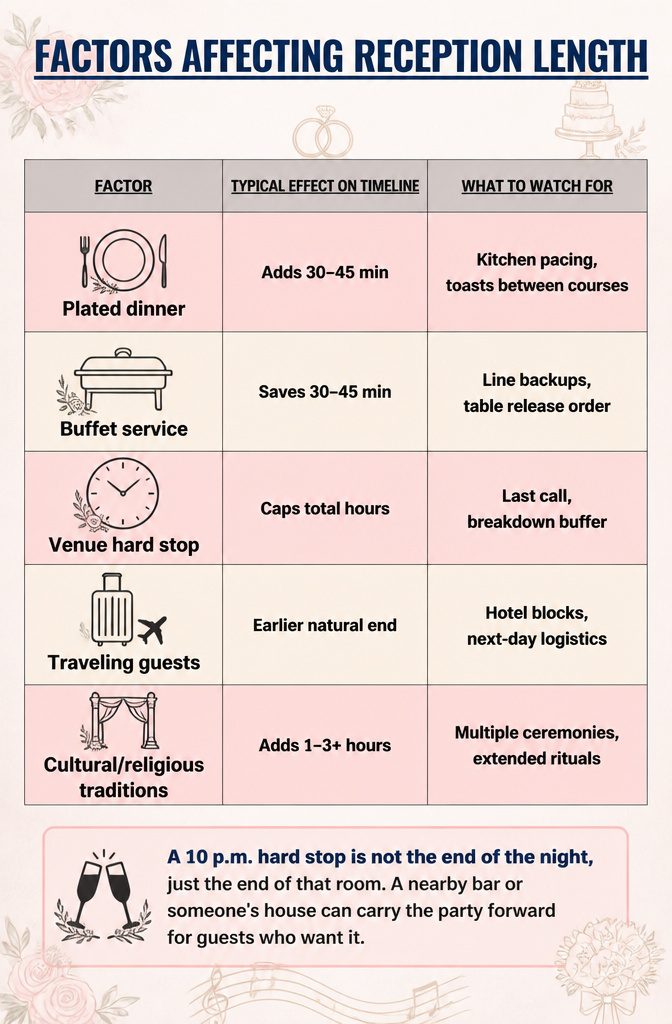
Plated service stretches a reception by 30 to 45 minutes compared to a buffet, since every course arrives in sequence and the kitchen paces the room. Buffets let guests move at their own speed, which compresses the eating window but can create bottlenecks at the line. Venue noise ordinances are harder to negotiate: a 10 p.m. hard stop means the last dance happens at 9:45 whether the crowd is thinning or not. Traveling guests, especially those with hotel checkout times or flights the next morning, tend to leave earlier; a reception heavy with out-of-town family often feels quieter after 9 p.m. Cultural and religious traditions can add formal elements that extend the timeline significantly, with some ceremonies and receptions running 4–6 hours combined for Western weddings and longer for traditions that include multiple rituals.
| Factor | Typical Effect on Timeline | What to Watch For |
|---|---|---|
| Plated dinner | Adds 30–45 min | Kitchen pacing, toasts between courses |
| Buffet service | Saves 30–45 min | Line backups, table release order |
| Venue hard stop | Caps total hours | Last call, breakdown buffer |
| Traveling guests | Earlier natural end | Hotel blocks, next-day logistics |
| Cultural/religious traditions | Adds 1–3+ hours | Multiple ceremonies, extended rituals |
A 10 p.m. hard stop is not the end of the night, just the end of that room. A nearby bar or someone’s house can carry the party forward for guests who want it.

Easy to See: Designed with big numerals by AKCISOT.

Easy to See: Designed with big numerals by AKCISOT.

Personalized invitations and stationary. Printed on 100 lb cardstock. Order only what you need!
Guest Energy and When to End
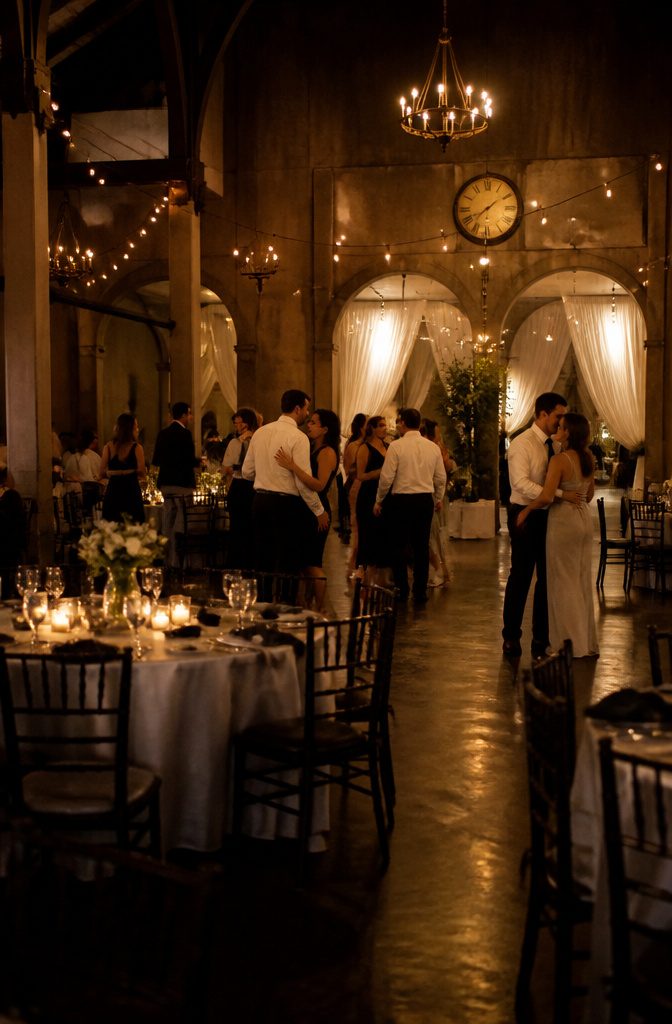
The real clock at a wedding runs on guest energy, not the contract hours you paid for. I learned to watch the room: the dance floor empties in patches first, then chairs get dragged to the perimeter so people can sit without leaving the party, and the bar line thins to just the die-hards. Those three signals together mean the peak has passed, and stretching past it does not create more fun, it creates more waiting.
Five hours hits that peak cleanly; six is the absolute ceiling before the room starts hollowing out. At my own wedding, we pushed to midnight and by then ten of us remained. We could have moved to a bar hours earlier and had the same night with less dead air.
The afterparty solves the split crowd without holding anyone hostage. Move it off-site, a hotel bar or a hired car, so the night owls keep going and the early-to-bed guests slip out guilt-free. The venue ends strong, the people who want more get more, and nobody is trapped watching the lights come up.

LONG-TERM COUNTDOWN CAPABILITY: This digital countdown clock allows you to set timers for up to 9,999 days, making it ideal for tracking long-term events such as retirement dates, wedding anniversaries, and more. Stay aware of how much time is left before your big day arrives, ensuring you are always prepared and on track.

【999days Countdown timer】Working range from 0 to 23h/59m/59s of the 999th day.Giving alarm for 1 min, after count back is finished.

LED countdown Timer & Clock-----This is a clock with 12 / 24 hour system;This is a Days countdown timer,it has a max count down up to 999 days 23 hours 59 minutes;This is a stopwatch,the maximum time is 999 hours,59 minutes and 59 seconds
Venue Rules That Decide for You
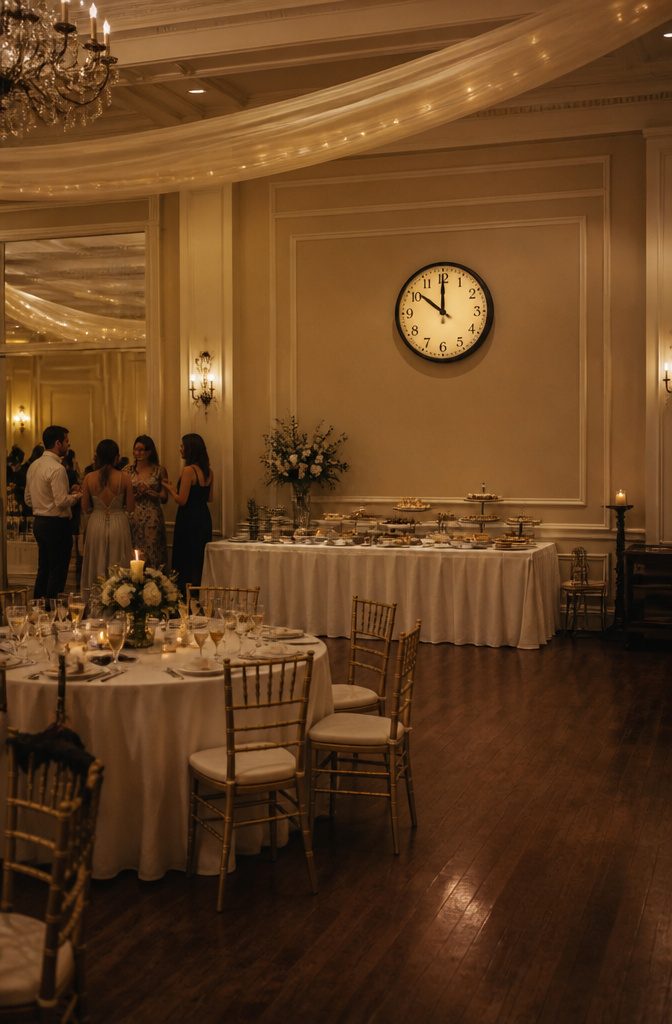
Some venues hand you the timeline before you even ask. A hard 10 p.m. music cutoff in a residential zone means the entire reception compresses into whatever hours remain after the ceremony, not the other way around. I have worked within that exact limit. The ceremony moved to 4:30 p.m., cocktails ran until 6:00, and dinner had to be plated by 6:45 so the first dance, toasts, and cake cutting could all land before 8:30. Dancing still got a solid ninety minutes, but there was no room for a leisurely meal or late-night snacks.
Sunday weddings carry their own earlier last calls, and some rental packages charge steep overtime if you push past the block. Starting earlier is usually the better trade than paying premium rates for an extra hour most guests will not fully use. The 10 p.m. exit felt early in the moment, but the full six hours of event time stayed intact; the after-party simply relocated to a hotel bar.

✅PROTABLE DJ PARTY LIGHTS - Rotating disco ball light*2, rgb par light*2, and comes with with a foldable/ detachable/ retractable tripod stand, easy to set up and tear down in minutes, great lighting system for parties with vivid colors, perfect lighting solution for the mobile band/ wedding/ DJ/ stage.

【Multiple Working Modes】U`King stage par light(Corded Electric) consists of 36 high-quality 36x1W LED lamp beads. There are 7 working modes: Static color, strobe, automatic, voice control, master-slave, DMX, gradient mode. Ultra-high brightness, more stable, lower power consumption.

Make Your Party More Dazzling: NEQUARE Party Lights add a magical charm to your party with updated colorful bulbs, 3 sound-activated modes, 7 lighting modes, flash and rotation speed control, and flicker speed control, allowing you to easily switch between lighting themes and create a colorful party atmosphere
Frequently Asked Questions
How long does a wedding reception last?
Most wedding receptions run 4 to 6 hours, with 5 hours being the number most planners and venues settle on. Five hours splits cleanly into one hour for cocktails, two for dinner and toasts, and two for dancing. Six can work if your crowd has the stamina, but past that point the energy thins and the room empties before the DJ plays out.
How long should the cocktail hour be?
Sixty minutes is the standard that keeps the evening on its feet. Stretch it to 90 minutes and guests get too loose too early, or they get hungry and the room turns restless. The couple usually slips away for portraits during this window, so budget your photo time inside that single hour.
How long should the dancing portion last?
Two to three hours is the window where the DJ earns their fee and the floor stays full. Ninety minutes is the sweet spot for a five-hour reception; stretch to six hours and you might get three, but the same friends who begged for one more song at hour two are slumped in chairs by hour four.
Should you have a wedding afterparty?
If you know your friends will still have it in them, yes. Move it off-site to a hotel bar or a hired car so the night owls keep going and the early-to-bed guests slip out guilt-free. It lets you end the venue strong while the people who want more get more.