
A Protestant church wedding is a worship service in which a couple makes vows before God and a congregation, treating marriage as a covenant that mirrors the relationship between Christ and the church.
The structure changes sharply by denomination: Episcopalians follow the Book of Common Prayer with formal liturgy, Baptists lean toward congregational participation and simpler ritual, and Lutherans often include communion.
Episcopal canons require at least 30 days’ notice, though booking the rector and the date runs longer than that minimum.
What Protestant Wedding Ceremonies Express
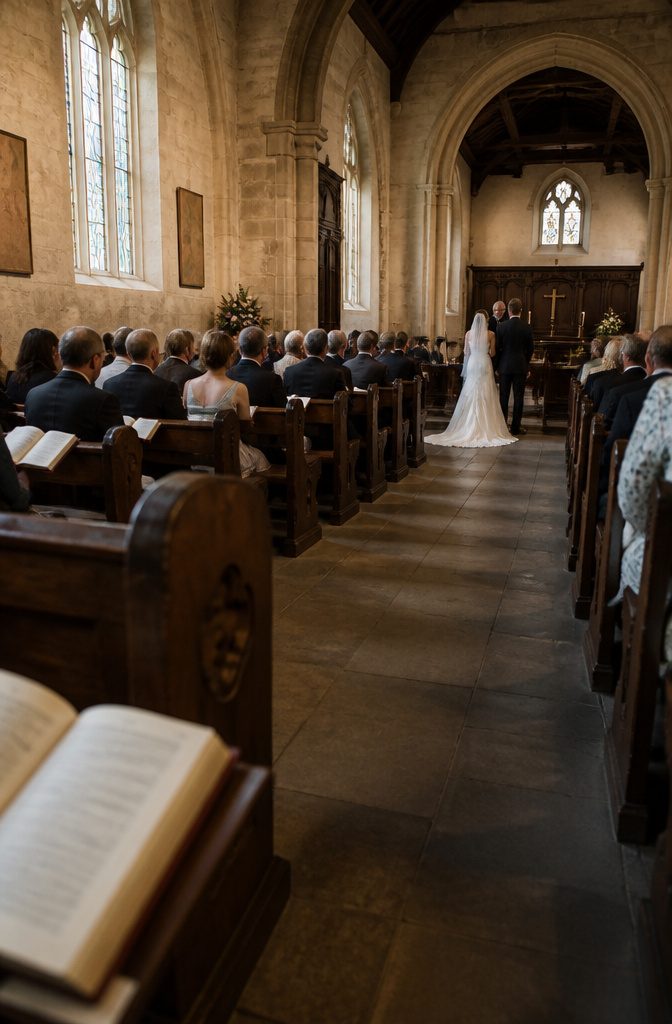
A Protestant wedding ceremony is a worship service, not just a formality. The couple stands before God to enter a covenant, treating marriage as a sacred estate that reflects the relationship between Christ and the church.
The opening welcome often names this plainly: you are here to witness a union in Christian marriage, in the Lord’s house, as a testimony of faith.
Guests do not sit in silence. Protestant services draw everyone into participation.
You sing hymns, hear Scripture read aloud, and respond when the officiant asks whether you will support the couple in their marriage. Some couples take communion during the ceremony, turning the moment into shared worship.
The exchange of vows is not a private transaction but a public proclamation of the Lordship of Jesus, spoken in front of a congregation that carries the responsibility of bearing witness.
1. How Practice Varies Across Denominations
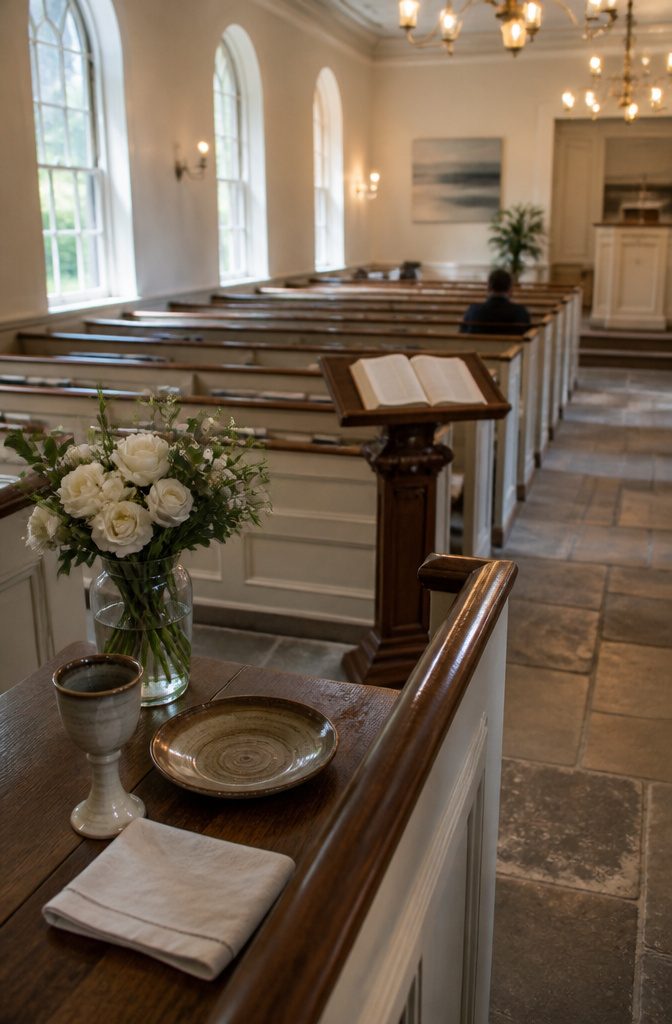
Protestant groups include Baptists, Lutherans, Methodists, Episcopalians and Presbyterians, and the differences in their theology show up directly in how they structure a wedding service.
A Lutheran ceremony leans on liturgy and often includes communion. Baptists tend toward simpler services with more congregational participation and less ritual.
Episcopalians follow the Book of Common Prayer, which gives their weddings a formal structure close to Anglican tradition. Methodists and Presbyterians fall somewhere in between, with room for both traditional and contemporary elements depending on the congregation.
The relationship between Christ and the church shapes Protestant wedding theology, and that parallel between divine and marital covenant is reflected in vows, readings and sermon content.
Expect variation rather than a universal script. Two Baptist churches in the same town might run very different services, and a Presbyterian wedding in one state may look nothing like one across the country.
2. Episcopal Service Structure
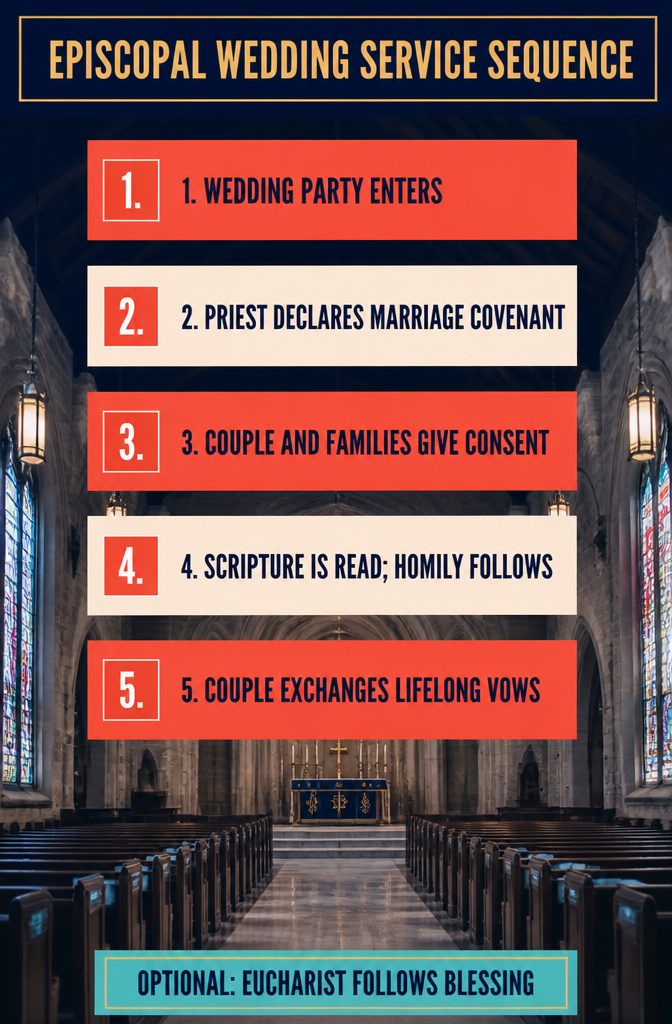
- Processional: The wedding party enters in order while music plays—typically bridesmaids first, then the bride with her escort.
- Opening declaration: The priest addresses the congregation on the meaning of Holy Matrimony as a covenant before God, using the language from the Book of Common Prayer.
- Consent: The priest asks the couple and their families whether they freely enter this marriage and support it going forward. Everyone answers aloud.
- Scripture readings and homily: One or more Bible passages are read, followed by a short sermon or reflection on marriage.
- Vows: The couple repeats their promises after the priest, stating they take each other for life in sickness and health.
- Exchange of rings: The rings are blessed, then given with a set form of words.
- Pronouncement: The priest declares them husband and wife.
- The Lord’s Prayer: The congregation recites it together.
- Additional prayers: The deacon or priest leads petitions for the couple, the world, and the church. People respond "Amen" after each.
- Blessing: The priest blesses the couple and dismisses the congregation.
- Peace: The couple and guests exchange a sign of peace.
- Optional Communion: If the couple chooses, the Eucharist follows the blessing. Not required.
This structure applies to Episcopal weddings. Other Protestant denominations follow different orders.
3. Book of Common Prayer Ceremony
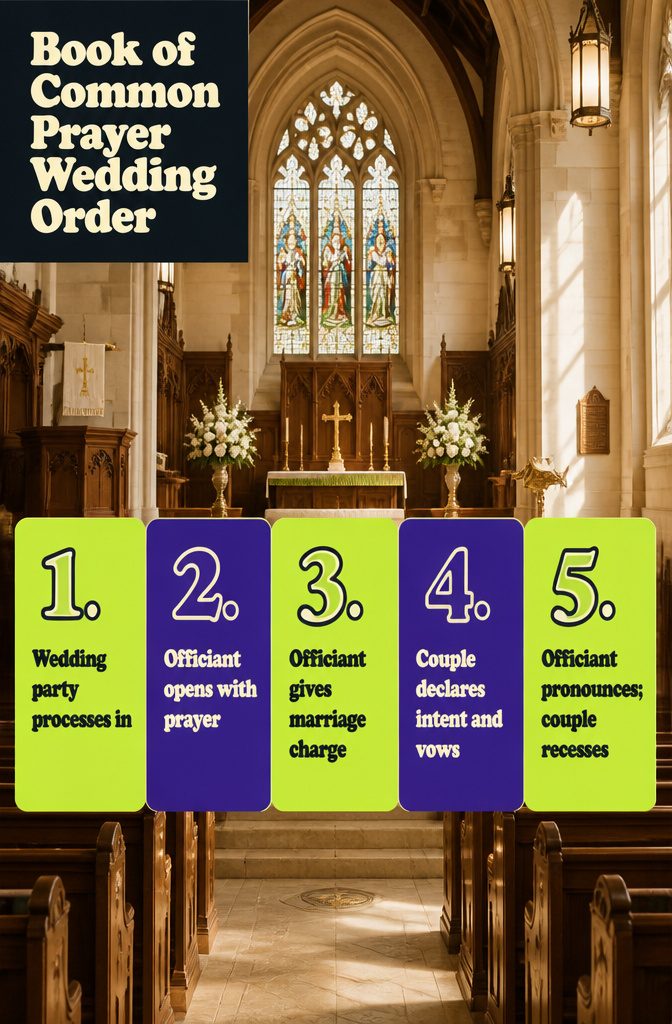
- Procession. The wedding party enters, typically with groomsmen and bridesmaids paired, followed by the bride escorted by her father or another chosen person.
- Invocation. The officiant opens with a prayer, acknowledging the presence of God and asking for blessing on the ceremony.
- Interrogation and Charge. The officiant addresses the congregation, asking if anyone knows a reason the couple should not be married. This part also includes a charge to the couple about the seriousness of marriage.
- Presentation. The person escorting the bride presents her to the groom, often in response to the question "Who gives this woman to be married to this man?"
- Declaration of Intent and Vows. Each person states their willingness to marry and speaks their vows, pledging lifelong commitment.
- Ring Exchange. The couple exchanges rings, with each ring blessed and given as a token of the marriage covenant.
- Pronouncement and Recession. The officiant declares the couple married, and they process out together as husband and wife.
4. Contemporary Baptist Service
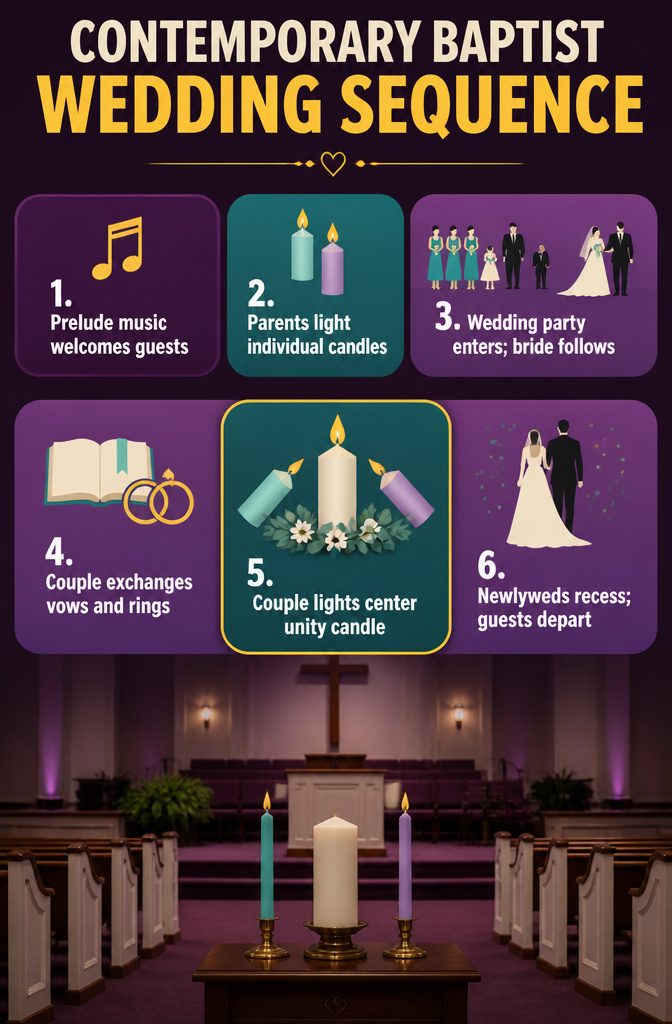
- Prelude music plays as guests arrive and take their seats.
- The groom’s parents walk to the front. Before the groom’s mother is seated, she and the groom’s father light the groom’s individual unity candle.
- The bride’s parents walk forward. Before the bride’s mother is seated, she and the bride’s father light the bride’s individual unity candle.
- The wedding party processes down the aisle: bridesmaids, groomsmen, flower girl, ring bearer, and finally the bride with her escort.
- The officiant delivers a welcome and explains the purpose of gathering.
- The officiant asks who gives the bride in marriage. The father or escort responds, then takes a seat.
- The officiant leads an invocation, praying for the couple and the ceremony.
- The officiant reads a statement on the meaning and permanence of marriage.
- The couple exchanges vows, either repeating after the officiant or reading their own.
- The couple exchanges rings, with the officiant blessing the rings and each partner placing one on the other’s hand.
- Songs are sung and prayers offered for the couple’s life together.
- The bride and groom light the center unity candle together from the two individual candles their parents lit earlier, symbolizing two families becoming one.
- The officiant declares the couple married.
- The officiant introduces the newlyweds by their married names.
- The couple recesses back down the aisle as husband and wife.
- Postlude music plays as guests exit.
This order comes from The CSB Minister’s Bible, structured by Jim Henry, pastor emeritus of First Baptist Church in Orlando, Florida.
Optional Elements in Protestant Services
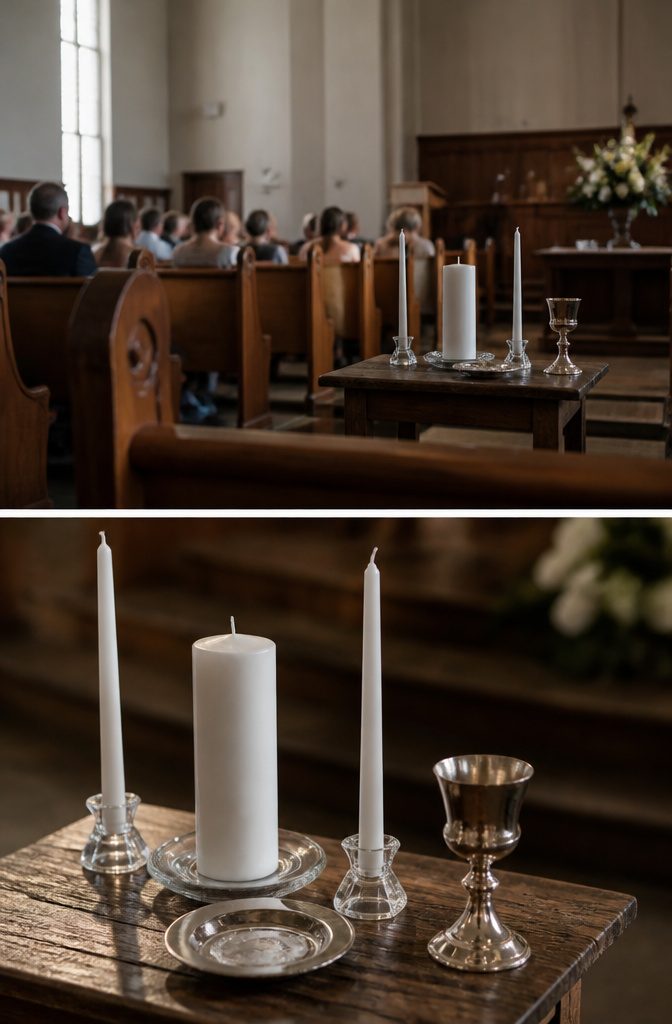
Some Protestant ceremonies include Communion, unity candles, songs or additional prayers, though none of these are required. Whether you add them depends on your denomination and what matters to you as a couple.
- Communion is common in Lutheran and Episcopal services, less so in Baptist or nondenominational ones. Some churches reserve it for baptized members, so if you want guests to take part, check with your officiant first.
- Unity candles remain popular as a symbol of two families joining. You and your partner each light a taper from separate candles, then light a central pillar together. Some couples skip this if the ceremony already feels long or if the sanctuary forbids open flames.
- Additional hymns or worship songs can be placed between readings or during the signing of the register. I prefer one or two strong choices over a packed program, but musical congregations often lean into more.
- Prayers for families or a blessing over the rings are optional additions that many officiants will include if you ask. These add a minute or two and work well when you want parents or the wider congregation involved without adding formal roles.
Church Requirements and Planning Timeline
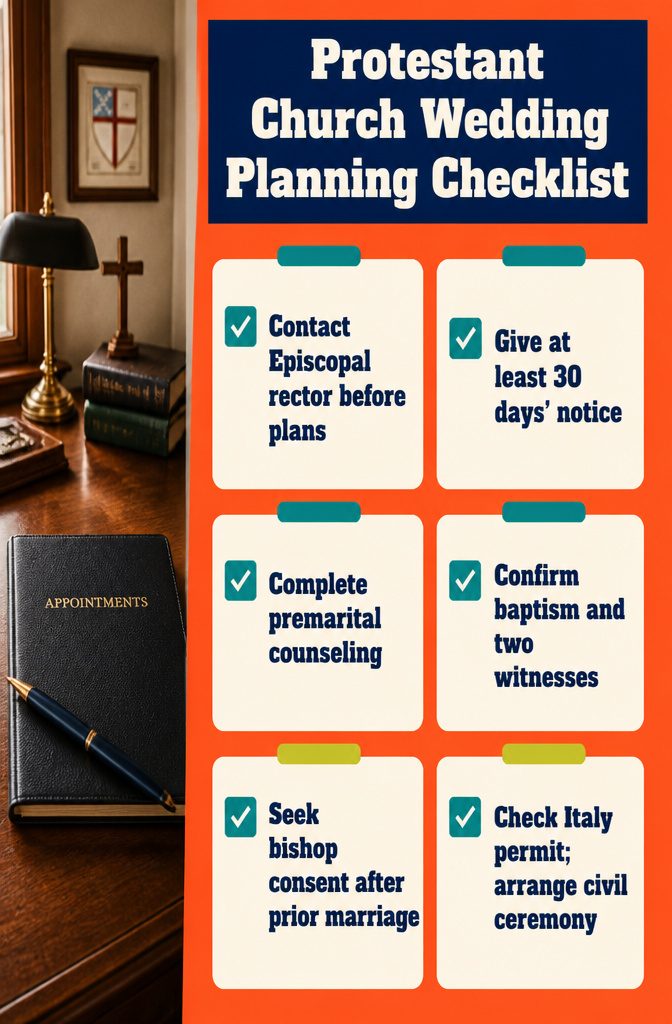
Requirements change by denomination and by your situation. Episcopal churches ask couples to contact the rector before finalizing other plans, because advance notice of several months is standard rather than a courtesy.
The canons require at least 30 days’ notice, but booking the date and the priest’s schedule both run longer than that minimum.
Episcopal rules also require premarital counseling, at least one party baptized Christian, and at least two witnesses present at the ceremony.
The marriage must comply with state law and church canons. If either party was previously married, the priest needs the bishop’s consent to proceed.
Planning a Protestant wedding in Italy introduces a separate set of rules. Some pastors hold the permit to make the ceremony legally binding, but many do not.
Without that permit, you arrange a civil ceremony before the church service or a few days after. Protestant churches that host weddings operate in Florence, Venice, Naples, Milan, Capri, and along Lake Como.
Catholic Permission Questions
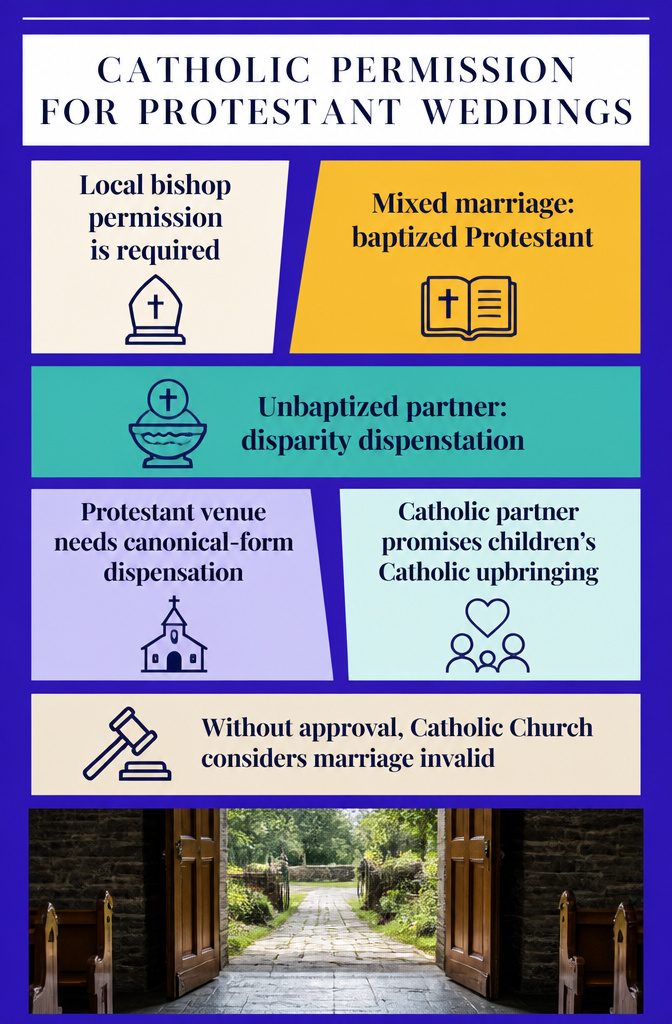
When a Catholic marries someone outside the Catholic faith, the Catholic partner must promise to do what they reasonably can to baptize and raise any children Catholic.
The non-Catholic spouse is not required to make the same promise. The Catholic also needs permission from the local bishop for the marriage to be recognized by the Church.
If marrying a baptized Protestant, that is called permission for mixed marriage. If marrying someone who was never baptized, it is a dispensation from disparity of cult.
Catholics who want their wedding in a Protestant church rather than a Catholic one need a separate approval, called dispensation from canonical form.
For instance, if the Protestant spouse’s father pastors the local Baptist church and wants to officiate, the bishop might grant that dispensation.
Without it, the Catholic Church considers the marriage invalid, even if the Protestant church and civil law recognize it. These are Catholic Church policies, not requirements the Protestant church imposes.
Whether Catholics May Attend
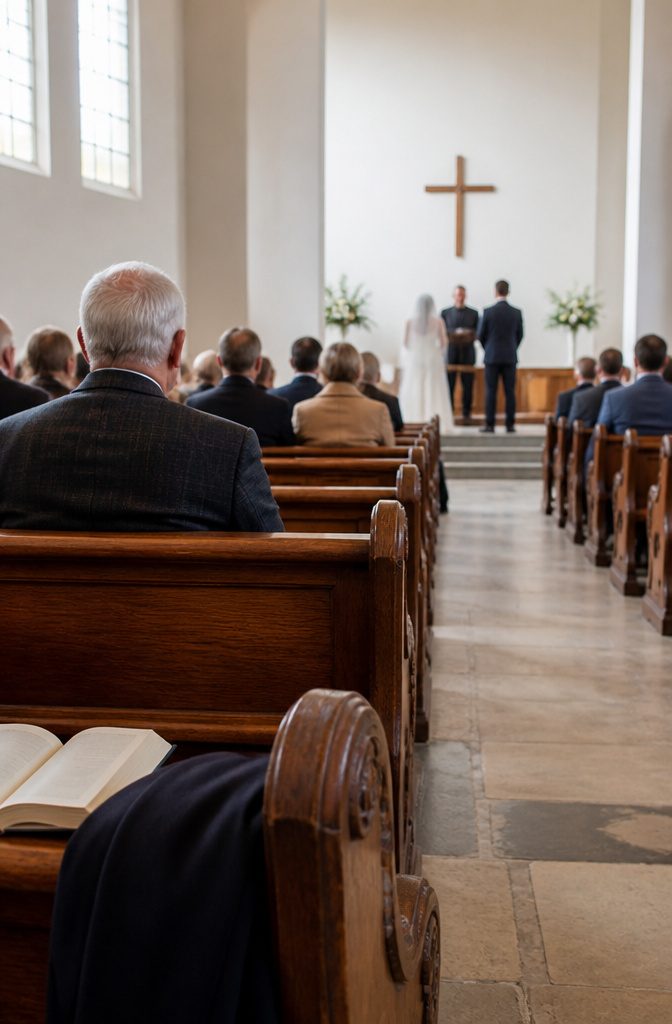
Catholic guidance on attending a Protestant wedding turns on whether the marriage itself is considered valid.
If both parties are baptized Protestants marrying in a Protestant church, a Catholic may attend — the Church recognizes those marriages as sacramental because the couple, not the officiant, makes the sacrament present through their consent.
The officiant’s denomination does not affect validity.
The calculus shifts when a Catholic is one of the parties.
A Catholic marrying a baptized Protestant must obtain permission for mixed marriage from the bishop. A Catholic marrying outside the Catholic Church — in a Protestant church or any other venue — must obtain a dispensation from canonical form.
Without that dispensation, the marriage is not valid in the eyes of the Church, and attending would amount to endorsing a union the Church does not recognize.
The same reasoning applies if either party has an unresolved prior marriage bond or if other impediments exist that prevent a valid sacrament.
Frequently Asked Questions
What do Protestants believe about marriage?
Protestants treat marriage as a sacred covenant entered before God, not a civil contract alone.
The union reflects the relationship between Christ and the church, which is why vows, readings, and the sermon all circle back to that parallel. Theology varies across denominations, but that covenantal foundation is shared.
What is the difference between a Catholic wedding and a Protestant wedding?
The most structural difference is sacramental theology: Catholics hold that marriage is 1 of 7 sacraments administered by the Church, while Protestants generally see it as a sacred estate or covenant rather than a sacrament in that technical sense.
Catholic weddings require canonical form, a Church minister, and bishop permission for mixed marriages; Protestant services vary widely by denomination and congregation, with far less centralized rule-making.
Communion is common in Lutheran and Episcopal ceremonies but optional elsewhere, whereas a Catholic Nuptial Mass is the norm for 2 baptized Catholics.
What are the traditional Protestant wedding vows?
Protestant vows follow the pledge of lifelong commitment through the classic formula of taking each other in sickness and in health.
Episcopal services use the exact wording from the Book of Common Prayer, where each person repeats the vow after the priest; Baptist services may use the same structure or allow the couple to write their own.
The specific words vary by denomination and officiant, but the promise of exclusive, permanent commitment is the constant.
Are Catholics allowed to get married in a Protestant church?
A Catholic can marry in a Protestant church, but only with a dispensation from canonical form granted by the local bishop.
Without that dispensation, the Catholic Church considers the marriage invalid, even if civil law and the Protestant church recognize it fully.
A common situation where a bishop might grant it is when the Protestant spouse’s parent pastors that church and will officiate.
Is it a sin to attend a wedding in a Protestant church?
Catholic guidance says attending is fine when both parties are baptized Protestants marrying in a Protestant church, because the Church recognizes those marriages as sacramental.
The question gets more complicated when a Catholic is 1 of the parties: if that person did not obtain the required permission or dispensation, the marriage is not considered valid by the Church, and attendance becomes more fraught.